


|
|
|
| ||||
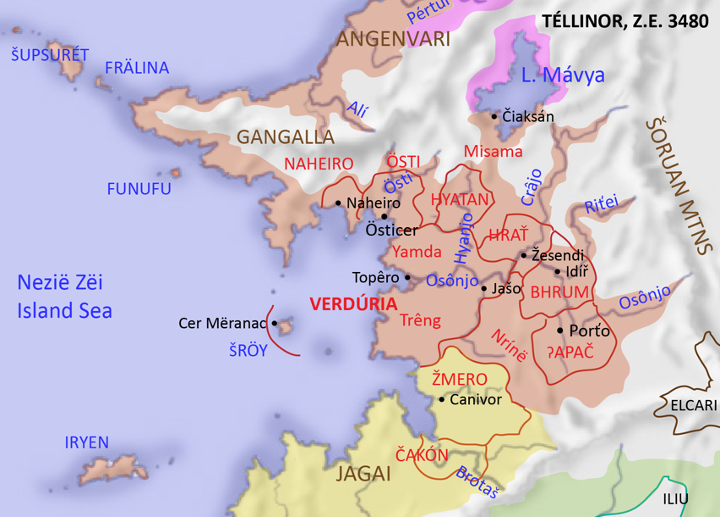
Yamda is the language of the region of the same name in Téllinor. It belongs to the Yamda-Trêng family which includes most of greater Téllinor and southern Angenvari.
This is the earliest presentation of Yamda grammar in Eretald, pubished in 3409. I’ve provided Foriy’s sketch for its historical interest; also because it’s a record of the language as it was before colonization. Modern Yamda has been thoroughly changed by borrowing from Verdurian, Kebreni, and Xurnese, which now provide over 30% of the lexicon, and have significantly changed its syntax.
No better grammar existed in 3480: the University did not produce one till Kubah Orgaric’s of 3491. To learn Yamda before then, you read Foriy, supplemented by one or more dictionaries, and the Navy’s Guide to the Speech of Yamda, which gave useful lists of common expressions and covered a few things Foriy didn’t.
I’ve corrected Foriy’s transliterations to match later scholarly practice, consistently used boldface for Yamda, and added explanatory notes in red. I have also supplied glosses for his sample sentences. I have retained his involved diction and quirky capitalization, a style which was characteristic of the 3300s (but not universal).
Needless to say, I do not endorse Foriy’s view of the Téllinorese. But I should point out that he was by no means the worst; he was a friend to many Téllinorese and married one, was respected as a fair administrator, and was interested in Téllinorese culture. But few of the settlers could get past a reflexive attitude of Eretaldan cultural superiority, and as Foriy himself complains, most were poor exemplars of Verdurian civilization.
—M.R.
I acquired a competence in the tongue of the Indigenes. Governor Lotom encouraged me to make my notes available, both for the smooth administration of Government, and to meet the curiosity of Scholarship, and he kindly arranged for their Publication in Verduria-city. This has led to a wholly unexpected correspondence with Scholars, colonial Officers, and Merchants, asking about every point of this previously unknown Tongue.
It beame evident that only a fuller Presentation could assuage the curiosity of the public, and thus, upon my retirement, I have finally provided such in this small Book, retaining, however, full consciousness of its many Shortcomings. There is no room to name all those that have sent inquiries, nor those who have generously shared their own understanding with me, but I must especially mention Lieutenant Osör Ružeon, who has published his own notes on the Bhrumese dialect, and urged me to contribute my grain of sand to the ever-growing heap which is Verdurian Science.
They worship multiple savage gods or faga, of which I have written in another Book. Their rituals are marked by a striking superabundance of Passion, which they explain as a god or spirit taking over their Body and Mind. We are told that our own primitive ancestors were so possessed by Fantit. The purpose is to seek guidance or healing, though the Feverishness induced by alcohol, exertion, and wild Music may lead instead to immorality or mere Stupor.
They are great traders, taking their Boats across the country to distribute the products of the land; and a Verdurian who wishes to do business in the country will find ready hands to distribute them to the farther tribes. They will do so responsibly and loyally so long as they are not denied their pay. The Verdurian must remember that to a native, the mark of a superior man is his Generosity, and the surest path to the loss of their respect is a perception of Miserliness.
They are dissolute in morals, and Verdurians who go there start to follow them in their feasts and revels, taking up concubines and even following the native gods. For every enterprising Verdurian Man who makes his fortune in the colony, there are half a dozen who are ruined morally and financially. For this reason Governor Lotom required that no Seaman be posted in the colony for a period of more than two years.
In the absence of Verdurian women, the Téllinorese women are comely, and rather than the path of dissolution, many a Verdurian has taken one as Wife. Though he will have nothing to complain of in domestic Happiness, such a marriage should not be taken lightly, as to the people a marriage is a uniting of Clans (predaga). The husband must be prepared to offer gifts to the family, not only before the wedding but on a continuing basis, and to favor the Clan in business. If this is done to their satisfaction, however, the Clan will be of great use in Business, and the Verdurian will himself be considered by the natives as well-established and trustworthy. He who consorts with concubines, however, will be as damaged in his Reputation as in his Virtue.
The dialect spoken in the colony is called by the indigenes Yamda, after themselves, “The People.” Just to the south is the nation of Trêng; along the river to the east is Bhrum; and on the northern coast is Östi.
Even within the Yamda nation there are variations, but the speech of Topêro, which I have documented in this book, will be understood. With some adjustments the speech of Trêng and Bhrum may be understood, and I have provided helpful Notes for this task. The indigenes of these nations will be more apt to understand a Verdurian speaking the dialect of Topêro, than will he be able to understand their dialects.
Many of the indigenes have learned the Verdurian language; but I must counsel against a simple reliance on this fact. Only a small minority know our language, which is greatly limiting to one’s Connections and Knowledge. Hiring a servant, or even doing business in the markets, will be enormously facilitated by an understanding of native speech; nor is it prudent for an officer or a businessman to undertake their Professions, unable to understand what the indigenes are saying among themselves. If a person cannot learn the language he must absolutely have at hand some reliable person who does.
Letters not used in native words are K Ř Č Ď k ř č ď. As is natural, these are used to record Verdurian words.
U A O E C Y K Ř P C B G D S u a o e i y k ř p c b g d s ɯ a ɤ e i j — — p k b g d s Š Z Č T ƒ R H L M F N V Ž š z č t ď r h l m f n v j ʃ z — t — r h l m f n v dʒ
The letter Ž ž is articulated more harshly than ours, exactly like the J j of Flaidish.
The letter H h must be pronounced as an exhalation of breath, as it is heard when spoken by the better classes in Žésifo.
Most difficult for Verdurian speakers is a sound written G or K or GN g k gn, which is a weak form of n wherein the tongue takes the position of c or g. Though no civilized speech has it, it can be found in the tongues of Dhekhnam and Obenzaya.
Almost every Sound may be followed by a Y y, which softens and feminizes it, much as in the Verdurian words le > lë.
As in Barakhinei speech, there are two ways to pronounce e and o, one pronounced strongly, with the tongue higher in the mouth, the other more weakly. The latter sounds are here written Ê Ô ê ô.
I counsel asking a native to pronounce ne ‘I’ and nê ‘chicken’, and imitating his pronunication until he can reliably report which word you are uttering. A benefit of this Experiment will be that you will not be subject to native Derision if you refer to yourself as nê.
Stress is regularly placed on the Penult, the next to last syllable. If a Verdurian word is not so stressed, the native cannot pronounce it correctly; thus šerë ‘beer’ becomes širya.
It is well to remember that the Meaning of a word may differ in the dialects. More than one Verdurian has been shamed to learn, or should have been shamed if he knew, that the innocuous word ryala ‘woman’ is taken by the Bhrumese to mean a woman who sells her virtue. But other less striking confusions are very common: byudo means to leave or abandon, but in Bhrumese, to complete.
SCA2 CATEGORIES GEN INPUTS V=aeiouêôæəüö
C=ptkbdgylrhwnŋmčjžšɦȟḇḏḡ
B=ouô
O=oe
Ô=ôê
U=uoa
Y=üöæ
E=eiæ
T=ptkčš
D=bdgjž
H=ḇḏḡjž
N=nŋm
bh|ḇ
dh|ḏ
gh|ḡ
V=aeoiu
C=ptknlrbmdgyčɦhŋmj
K=nptlkhbdgɦrjwm
N=nŋ
S=rɦhtkpsm
CV
CyV
CrV
CVN
CVSYAMDA TRÊNG BHRUMESE ɦy/v/#_ gy/h/_
j//_y
ɦ/v/#_B
ɦ/f/#_
ɦ/f/_#
ɦ/g/V_V
č/š/_
O/Ô/_CC
O/Ô/_C#
ly/y/V_V
my/w/V_V
n//V_C
h//_#
t//V_C
tr/j/_
o/ô/_Co
p/m/_y
ny/y/#_
jy/ž/_
ly/ž/_
ry/w/_
T/D/_y
l//V_V
l//V_#
O/Ô/_CC
O/Ô/_C#
g/gy/_e
g/gy/_i
a/e/_CB
a/e/_CCB
r/d/V_V
r/y/č_V
č/š/#_
č/š/_#
nd/ŋ/_
r//V_C
hy/š/_
s/š/_C
s/š/_#
p/f/_#
k/ȟ/_#
j/ž/_#
a/ai/_N
e/i/_N
ô/u/_N
ty/č/_
U/Y/Ty_
U/Y/Dy_
U/Y/_CE
T/H/#_V
T/H/#_r
D/T/#_V
y//_Y
ry/ly/_
i//Cr_
a/æ/_N
a/æ/_č
o/ə/_ŋ
a/ə/VC(C)_#
o/ə/VC(C)_#
e//_#
e/a/_r
m/ḇ/V_V
D/H/V_V
č/ž/V_V
n//E_
eh/a/_#
oh/o/_#
ye/i/j_
As a simple example, let us take byera. The word means ‘to fish’ ihtüan and also ‘fishing’ ihtüát. Alone, it has either meaning; but with noun inflections it is a noun, and with verb inflections it is a verb. Thus byeraga ‘fishing expeditions’ or ôtabyera ‘after fishing’ act as Nouns; byerat ‘he fished’ or byerayên ‘I am fishing’, as Verbs.
To be more precise, it is the last suffix which determines the type of Expression.
Now let us consider two sentences using byera along with ryala ‘young woman’.
Byerayêt ng ryala.
Byerayêt ng ryala.
fish-impfv-3s nom maiden
The young woman is fishing.
Ryalayêt ng byera.
Ryalayêt ng byera.
maiden-impfv-3s nom fishing
The one fishing is a young woman.
The verbal suffixes yê-t mark their targets as Verbs, or we could say, turn them definitively into Verbs; but these suffixes may be applied indifferently to byera or to ryala. In a similar way the case marker ng signals that the following word, either byera or ryala, is used as a Noun. Doing some violence to our own Language, we might say that the native understanding of the second sentence is ‘Someone is young-woman-ing, and there is fish.’
An adjective can be used as a Noun, referring to things or persons of that Quality, but it is preferable then to give it a gendered or plural Noun inflection: šudo ‘poor’ thus becomes šudoga ‘the poor’ or šudoto ‘a poor man’.
The meaning is intensified by repetition: šudošudo ‘extremely poor’, dôndôn ‘extremely large’. This may be moderated by repeating only the first syllable: šušudo ‘very poor’, dôdôn ‘very large.’
The diminutive -y(e) will soften the meaning: šudoy ‘somewhat poor’, dônye ‘somewhat large.’
The suffix -nye is used much like our Genitive of Composition, showing what something is made of, or filled with: yana ‘sand’, yananye ‘sandy’; gôro ‘rock’, gôronye ‘rocky’.
The suffix da turns an adjective into an abstract Quality; thus jangda ‘strength’, dônda ‘largeness.’
To compare two persons or objects, one says something like this:
Yês is Cyaja, nêrt is Jola.
Yês is Kyaja, nêrt is Jola.
tall trigger Kyaja / short trigger Jola
Kyaja is tall, Jola is short.
That is to say, this conveys the meaning Kyaja is taller than Jola.
Six to nine are vôro šrija, vôro pyuli, vôro tyaša, vôro fima. Alternatively, vôro pan šrija ‘five with one’, and so on.
šrija one pyuli two tyaša three fima four vôro five
The word for ten is vôraro which is the dual of ‘five’; thus ‘two fives.’ One occasionally hears tyašaša for six, fimama for eight.
Multiples of five are pyuli vôroga 15, tyaša vôroga 20, hača 25. With these the unit digits are most often added with pan, thus tyaša vôroga pan fima 24.
It should now be possible to interpret pyuli hačaga pan vôraro pan tyaša ‘two 25 with 10 with 3’, that is, 63. The process may then continue with têyu 125.
A number may precede or follow a noun: pyuli ryala or ryala pyuli ‘two young women.’ When a number is given, the noun need not take a dual or plural suffix, though it is not incorrect to use one.
As we shall see below, pairs of objects are named using the Dual, thus pyuli is not often needed. We would normally say ryalala ‘a pair of young women’. One would use pyuli if counting, or if asked particularly about quantity.
It is a rare Verdurian who masters the native counting system; contrariwise, it is increasingly common for natives to use the Verdurian numbers even in Yamda, with some Accommodation to native speech habits: an, vun, vin, par, pan, sês, êp, žôk, nêv, dêk.
There are no words designated as Ordinals; rather a construction is used such as
šrija ôta dêyaga
šrija ôta dêyaga
one from woman-pl
one of women, that is, the first woman
If the Verdurian hesitates between ngêt and šô, it is usually safe to choose the first, which is incorrect only if the indicated Object is distant from both speaker and listener.
im this near ngêt that, not far šô that far
As there is no possessive adjective, when contrasted im and ngêt may have the implication ‘mine’ versus ‘yours.’ E.g. Dês ang im vena “Come into my house.”
To these may be applied the nominal suffixes to for a human, soy for an object. The combinations are however somewhat modified in Sound.
For completeness I give the pointers relating to Time and Space, though they are sometimes considered trustee nouns. In Time there are only two divisions.
into insoy this man / thing ngêto ngêtoy that man / thing šô šôsoy yonder man / thing
ir here ngil there, not far nad there, distant myaga now, at this time tyun then, at that time
The Dual is formed by repeating the last syllable. If the noun ends in a consonant, repeat the syllable instead.
The Plural is formed in two ways. The first and most general is via the suffix ga, or after a final consonant besides n, -eg.
baje egg bajeje two eggs kema hand kemama two hands dêya woman dêyaya two women rin hour ririn two hours far land fafar two lands byôdar child byôdadar two children vôro five vôraro ten ne I nene thou and I
The second form is formed with the suffix da, and forces a consideration of the Referent as a unity or collective. Compare with the above table the meanings below:
fa god faga gods far land fareg lands nê chicken nêga chickens yam human yameg people, humans
Nouns are not inflected by Case, but Case is indicated using a separate particle, which will be described under Relations.
fa god fada the pantheon, divinity far land farda the territory of the king nê chicken nêda poultry, the fowls owned by one man yam human yamda the Yamda people
More specific Reference may be attained by the use of certain Suffixes:
The entire noun may be repeated, with the Signification, many or all of these things:
to male la female y diminutive (after a consonant, -ye) soy an associated object vin place where an activity is done (after a consonant, in)
Myal creba creba ye pargin.
Myal kreba kreba ye pargin.
exist ship ship at dock
At the dock are ships upon ships.
The most common trustee nouns are these;
The middle columns will be explained below, when some knowledge of the verbs is attained. For reference, the object forms are abbreviations for expressions with e, and the beneficiary forms, for expressions with vo.
meaning basic obj benef I ne êm vên you (singular) pôr byo gô you and I ngo he or she dye êt re he dyet êt re she dyel êl re we kune you (plural) ku they kudye
For interrogatives the root is hal ‘which’, which naturally forms halto ‘who’ and halsoy ‘what’. In the term haye ‘where’ we can recognize the place suffix ye.
Rather than having a special word for ‘when’, Yamda makes do with expressions such as hal hyêr ‘which day’. In a like fashion, ‘how’ is hal giyo ‘which way’.
Finally there is the class called scolisecî or Quantity Trustees
These are combined in exactly the same way as hal; thus vayeto ‘no one’, prinye ‘somwhere’, šangsoy ‘many things’, jaha hyêr ‘all days, always’.
vaye none prin some šang many jaha every
Here is a sentence devised to show as many of these Relations as possible:
ng — actor e gyo- object acted upon (ek before a vowel) vo gê- beneficiary or indirect object ba na- instrument pan na- accompanying person ang ngo- destination, or later action ôta tya- source, or previous action har har- in the way of, like kara kara- reason or purpose ye ye- location is Promoted Passive; discussed with Verbs.
Cyol ng nêsla e nyêr vo lêsya ôta yêjo ye fêyin ba môrta.As shown, the verb tends to come first, but the native is indifferent as to the order of the other Nouns. No confusion is possible since each is accompanied by the particle which identifies its role. The following sentence is equally correct:
Kyol ng nêsla e nyêr vo lêsya ôta yêjo ye fêyin ba môrta.
give-3s nom shopkeeper-f obj date.wine to matron from upriver at shop with mug
The shopkeeper gave the matron the date-wine from upriver at the store using a cup.
Cyol ba môrta ye fêyin ôta yêjo ng nêsla vo lêsya e nyêr.
Kyol ba môrta ye fêyin ôta yêjo ng nêsla vo lêsya e nyêr.
give-3s with mug at shop from upriver nom shopkeeper-f to matron obj date.wine
The shopkeeper gave the matron the date-wine from upriver at the store using a cup.
Sandala is Cyaja.
Sandala is Kyaja.
princess trigger Kyaja
Kjaja is a princess.
Jang is Vedura.
Jang is Vedura.
strong trigger Verduria
Verduria is strong.
Ye tôyvin is cyaya.
Ye tôyvin is kyaya.
in kitchen trigger dog
The dog is in the kitchen.
A very similar expression uses the particle myal, which expresses existence: myal fa means “there is a god” or “a god exists.” A location is usually specified:
Myal šoga ye pargin.This can be reversed as well: Ye pargin myal šoga.
Myal šoga ye pargin.
exist box at dock
There is a crate on the dock.
Myal is also used for possession:
Myal braha is ne.Myal is not a verb and does not have a past or future tense. This deficiency may of course be rectified by providing a time period:
Myal braha is ne.
exist horse trigger I
I have a horse.
Myal hedar braha is ne.There are no Possessive Adjectives, but the case marker pan may be used: braha pan Kyaja ‘Kyaja’s horse.’
Myal hedar braha is ne.
exist yesterday horse trigger I
I had a horse yesterday.
In Grammar we distinguish expressions of State from expressions of Action. In Yamda it is more convenable to begin with completed Actions, which are expressed with the simplest possible form.
Let us consider the word harpa ‘hit, strike’. First, it is inflected by Person and Number.
As with nouns, there is a Dual number, though only in the first and third Persons. A Yamda will be scrupulous in using ngo when referring to himself and his interlocutor, where we would simply use the ‘we’ inflection. More than one Verdurian has been Surprised, uttering something as simple as verakun ora ‘we will talk’, to be warily or angrily asked what other Person will be present.
harpan I struck harpaw you (s.) struck harpaj he or she struck, it struck harpat he struck harpal she struck harpango you and I struck harpajo the two of them struck harpakun we struck harpaku you (plural) struck harpakoj they struck
The Gender inflections are used when a specific individual does the action. A generic or unknown person takes j only. I have never heard a Gender distinction used in the dual or plural, although Lt. Ružeon informs me that this is done in Bhrumese.
If a verb ends in another vowel, use that in place of a: gardon ‘I ate’. If the root of the verb does not end in a vowel, supply a: mêngan ‘I worked.’ We may say that for this class of words, the verbal root is indeed mênga, but in noun form the a is lost: thus mêng is ‘work, working’ while harpa is ‘a blow or hit.’
These expressions all imply that the action is complete. If it is a State— it expresses a process or is incomplete— we add the suffix yê:
The yê forms are indifferent as to time. In the past, they emphasize what action was ongoing. In the present, the yê form is usual, since in the present moment an action is either incomplete, or not done at all; or if done, that action immediately appertains to the past.
harpayên I am or was striking harpayêw you (s.) are or were striking harpayêj he or she or it is or was striking harpayêt he is or was striking harpayêl she is or was striking harpayêngo you and I are or were striking harpayêjo the two of them are or were striking harpayêkun we are or were striking harpayêku you (plural) are or were striking harpayêkoj they are or were striking
It is a frequent complaint of Verdurians that the natives mis-use the completive, reporting as done, work which is not done. If you are advised that “the document is written” or “the meal is cooked”, it may mean only that the worker is reassuring you that he takes the task seriously and intends to soon finish it.
Verbs whose root ends in a consonant do not here supply an a. Thus mêngyên ‘I was working.’
These forms are often used to give the background or ongoing task to which the main action is an interruption. For instance:
Mêngyên, lôdat ng nabyo.If the subject of both verbs is the same, the yê verb loses its person marking:
Mêngyên, lôdat ng nabyo.
work-impfv-1s come-3sm nom captain
While I was working, the ship captain arrived.
Lyugayê, tidil ng Cyaja e nyasa letanye.
Lyugayê, tidil ng Kyaja e nyasa letanye.
clean-impfv, find-3sf nom Kyaja obj bag coin-of
While cleaning, Kyaja found a bag of coins.
The suffix ôd casts doubt on the action, without denying it entirely: harpanôd ‘he may have struck’, harpayêwôd ‘you may be striking’. I have called this the Remote tense, as in Caďinor; this is misleading as to particular uses, but helpful as a mnemonic. The main usage is to indicate that the speaker does not have certain knowledge that the Action took place.
Prapatôd ng ryagiyto e rêyla.When speaking to a Verdurian, the native will use the tenses strategically. If he does not want to do something, or does not wish to implicate a relative, his report will express doubt and distance with ôd; if he wishes to please you, the action will be reported as completed and veridical regardless of reality.
Prapatôd ng ryagiyto e rêyla.
kiss-3sm-remote nom gardener-m obj servant-f
The gardener may have kissed the maidservant.\
There is no future tense as such, but the Yamda use, or mis-use, the word ora ‘tomorrow’ so that it effectively functions as one.
Lôdat ora ng nabyo.Here the time reference is exceedingly vague, anywhere from the next hour to the next month.
Lôdat ora ng nabyo.
come-3sm tomorrow nom captain
The ship captain will arrive (tomorrow).
It will be noted that the ordinary verb lôdat is used. As usual, this implies that that the event will be completed; compare
Mêngyêt ora ng nabyo.Though all know that the future is uncertain, both sentences are still appropriate if the event is certain (Pargat ora Abaša “The sun will rise”) or at least likely. The native is, of course, anxiously reassuring about the future when speaking to any Verdurian. Among themselves they are more apt to circumspection, and to use the remote tense to emphasize the inscrutability of time. You will note that your clerk, even if given certain knowledge that the captain is arriving soon, will inform another Yamda:
Mêngyêt ora ng nabyo.
work-impfv-3sm tomorrow nom captain
The ship captain will be working (tomorrow).
Lôdatôd ora ng nabyo.If ora is felt to be too remote, hyirin ‘soon’ will be substituted. The speaker by this wishes the listener to believe that the event is imminent, but feels no urgency himself.
Lôdatôd ora ng nabyo.
come-3sm-remote tomorrow nom captain
The ship captain may arrive (tomorrow).
An intensive is formed by repeating the first syllable of the verb. This indicates an action performed with a particular passion, or repeatedly. If harpa is ‘to hit’, haharpa is ‘to beat violently’; if nyêš is ‘to see’, nyênyêš is ‘to observe closely or obsessively’; if vera is ‘to speak’, vevera is ‘to babble or speak with prolixity.’
Let us start with two related sentences:
Harpal ng vempan e rêto.In the second sentence, the servant is now marked with is rather than the object case marker e, and the verb agrees with him (-at) rather than the mistress (-al). In addition the prefix gyo appears on the verb. As ever, the two nouns may appear in either order.
Harpal ng vempan e rêto.
strike-3s-f nom master-f obj servant
The mistress struck the servant.
Gyoharpat ng vempan is rêto.
Gyoharpat ng vempan is rêto.
TA-strike-3s-m nom master-f trigger servant
The servant was struck by the mistress.
The reader will see the parallel to our own Passive, which is why I have started here. But this Operation is fully general in Yamda, and may apply to any noun in the sentence, each of which has its own verb prefix. Here are some examples derived from the same sample sentence:
Cyol ng nêsla e nyêr vo byôr ôta yêjo.In making such variations, take heed to make the correct agreement on the verb, and do not neglect the correct prefix.
Kyol ng nêsla e nyêr vo byôr ôta yêjo.
give-3sf nom shopkeeper-f obj date.wine to boy from upriver
The shopkeeper gave the boy the date-wine from upriver.
Gyocyoj ng nêsla is nyêr vo byôr ôta yêjo.
Gyokyoj ng nêsla is nyêr vo byôr ôta yêjo.
TA-give-3s nom hopkeeper-f trigger date.wine to boy from upriver
The date.wine from upriver was given to the boy by the shopkeeper.
Gêcyon ng nêsla e nyêr is byôr ôta yêjo.
Gêkyon ng nêsla e nyêr is byôr ôta yêjo.
TA-give-3s nom shopkeeper-f obj date.wine trigger boy from upriver
The boy was given the date-wine from upriver by the shopkeeper.
Tyacyoj ng nêsla e nyêr vo byôr is yêjo.
Tyakyoj ng nêsla e nyêr vo byôr is yêjo.
TA-give-3s nom shopkeeper-f trigger obj date.wine to boy from upriver
From upriver was the boy given the date-wine by the shopkeeper.
The actor in the sentence, marked with ng, may instead be marked with is, with no change to the verb. The meaning is little changed, but this construction may be said to nudge the listener’s Attention to that person.
First, when agreement is marked on the verb, it is not necessary to use the trustee noun at all, though it is not incorrect. Thus harpan fully conveys the meaning “I struck”; one can say harpan ng ne, but one would only do so for clarity or emphasis, if there were questions as to the one striking.
This applies as well to participants promoted by Universal Passive. Thus gyoharpan means “I was struck”, which may be expanded to gyoharpan is ne.
Second, an inferior refers to a superior using a title (mada father, vôta boss, vempan master, nabyo captain, hyanto lord) rather than pôr, and the superior uses that same title rather than ne. However, the verbal inflections do not change:
Nuroyêw ng vempan e cawa cya?Third, there are abbreviations for common combinations of case marker and trustee noun; these have been given in the Trustee Nouns section. These abbreviations must appear just after the verb. Examples are êm ‘me’, vên ‘to me’.
Nuroyêw ng vempan e kawa kya?
want-2s nom master obj coffee Q
Does the master want coffee?
Cyol-vên ng nêsla e nyêr.Third, when the actor is demoted by Universal Passive, and is a trustee noun, it is also attached to the verb. We can say that the a trustee noun serves as an abbreviation for ng plus itself.
Kyol-vên ng nêsla e nyêr.
give-3sf for.1s nom shopkeeper-f obj date.wine
The shopkeeper gave me the date-wine.
Côršot-êt ng samto.
Kôršot-êt ng samto.
kill-3sm-obj.3s nom king
The king killed him.
Cyokyoj-ne is nyêr vo byôr.It is possible to use two of these abbreviations together, but not more.
Gyokyoj-ne is nyêr vo byôr.
TA-give-3s shopkeeper-f trigger date.wine to boy from upriver
The date wine was given to the boy by me.
Cyol-vên-êt ng nêsla.Where we would use a Reflexive, these abbreviations are appropriate instead:
Kyol-vên-êt ng nêsla.
give-3sf for.me obj.3s nom shopkeeper-f
The shopkeeper gave it to me.
Lyugal-êl ng ryala.By strict logic this sentence only says that the girl washed a female; context may be trusted to clarify.
Lyugal-êl ng ryala.
wash-3sf-obj.3sf girl
The girl washed herself.
If the verb root ends in a consonant plus y, add the root vowel: Hôkyo insoy! ‘Know this!’
Using the Universal Passive, an imperative may be addressed to an inanimate object:
Gyolyug is jawada!However, the root Imperative is too peremptory for any but children and servants. For peers, the ordinary verb is used: Gardow e nyura! ‘You eat the fish!’ Superiors should not be given orders, but ideally Hints. The proper Téllinorese servant tells his master, Nirta is nyura ‘The fish is ready,’ rather than Lôdaw ang gardo ‘Come to the meal.’
Gyolyug is jawada!
TA-wash trigger clothes
The clothes be washed!
These words can then be turned into Persons using the to and la suffixes. Thus harpato is a man who hits, gyoharpato is a man who is hit. A man who loves is rakyoto; the woman he loves is genrakyotla.
We distinguish between a noun baďi ‘hit(ting)’ and an infinitive verb baďir ‘to hit’, but harpa serves for both.
Pyejeyêt ryêye ng tacto.Ryêye may equally precede the verb.
Pyejeyêt ryêye ng takto.
walk-impfv-3sm slow nom hunter
The hunter was walking slowly.
Va racyoyêt ng ryagiyto vo rêyla.Va can be used to deny that a particular Participant contributed to the action; but this can only be done to the ng subject, or to a participant promoted by the Universal Passive.
Va rakyoyêt ng ryagiyto vo rêyla.
not love-impfv-3sm nom garderner-m to servant-f
The gardener doesn’t love the maidservant.
Va ye tôyvin is cyaya.
Va ye tôyvin is kyaya.
not in kitchen trigger dog
The dog is not in the kitchen.
Va myal braha is ne.
Va myal braha is ne.
not exist horse trigger I
I don’t have a horse.
Racyoyêt va ng ryagiyto vo rêyla.The Case Marker may in fact be omitted in these sentences.
Rakyoyêt va ng ryagiyto vo rêyla.
love-impfv-3sm nom garderner-m to servant-f
It is not the gardener that loves the maidservant.
Gêracyoyêl ng ryagiyto va is rêyla.
Gêrakyoyêl ng ryagiyto va is rêyla.
TA-love-impfv-3sf nom garderner-m not trigger servant-f
It is not the maidservant that the gardener loves.
This may be contrasted to vaye which is a generic negative like our suy [‘not any’]:
Racyoyêt ng ryagiyto vo rêyla vaye.
Rakyoyêt ng ryagiyto vo rêyla vaye.
not love-impfv-3sm nom garderner-m to servant-f none
The gardener loves no maidservants.
Racyoyêt ng ryagiyto vo rêyla cya?The response is Ngêt ‘that’, for yes, and vaye for no. Speaking to a Verdurian, the native will often use ar ar or řo řo even if they speak no other Verdurian. (As they cannot pronounce our ř, expect to hear this as ro or ho.)
Rakyoyêt ng ryagiyto vo rêyla kya?
love-impfv-3sm nom garderner-m to servant-f Q
Does the gardener love the maidservant?
Myal braha is pôr cya?
Myal braha is pôr kya?
exist horse trigger you Q
Do you have a horse?
Where we place other interrogatives at the beginning of the sentence, the Yamda place them at the end:
Prejej ora ang Topêro ng halto?
Prejej ora ang Topêro ng halto?
walk-3s tomorrow to Topêro nom who
Who is going to Topêro?
Ang Topêro is firjo haye?
Ang Topêro is firjo haye?
to Topêro trigger road where
Where is the road to Topêro?
Lôdat is dêsto sanyêšat e šreto.The relative clause is not marked, as in our language, by a trustee noun, but by a prefix sa on the verb.
Lôdat is dêsto sanyêšat e šreto.
arrive-3sm trigger male sub-see-3sm obj ghost
The man who saw a ghost has arrived.
The relative clause need not appear next to its target, but may be moved anywhere in the sentence.
Sanyêšat e šreto lôdat is dêsto.This is not difficult for the Verdurian, who then proceeds to apply the suffix to any Participant in the action. But this is incorrect, for only the main actor, or one promoted by the Universal Passive, may take a relative clause. That is, only a noun marked with is can relativize.
Sanyêšat e šreto lôdat is dêsto.
sub-see-3sm obj ghost arrive-3sm trigger male
The man who saw a ghost has arrived.
Here is how a sentence looks when the ghost-seer is the indirect object:
Gêverat-ne is dêsto sanyêšat e šreto.And here, if he is a companion to the speaker:
Gêverat-ne is dêsto sanyêšat e šreto.
TA-speak-3s-1s trigger male sub-see-3sm obj ghost
I spoke to the man who saw a ghost.
Nagardot-ne is dêsto sanyêšat e šreto.To recapitulate, if the Participant who is the target of the relative clause is the main actor, one has only to mark the subordinate verb with sa and make sure to mark the actor with is rather than ng. But if it is not the main actor, the procedure is as follows:
Nagardot-ne is dêsto sanyêšat e šreto.
TA-dine-3s-1s trigger male sub-see-3sm obj ghost
I dined with the man who saw a ghost.
This is done by placing the helping verb in the yê or incomplete form, with no personal ending, exactly the construction we have seen for a background event. Thus:
Môryoyê verayêl ng ryala har Vedura.The second Kind is the word root used as a noun.
Môryoyê verayêl ng ryala har Vedura.
can-impfv speak-impfv-3sf nom girl way Verduria
The girl can speak Verdurian.
Duryayê nyêšaw e ryôjo.
Duryayê nyêšaw e ryôjo.
should-impfv see-2s obj dancing
You ought to see the dance.
Va numel is lêsa e jona-ne ang emyahto.This is exactly the form of Va numel is lêsa e ryôjo ‘My mother doesn’t like dancing’, but here the nominalized verb has its own subject and object.
Va numel is lêsa e jona-ne ang emyahto.
not like-3sf trigger mother obj visiting-1s to shaman
My mother doesn’t like my visiting the shaman.
Nurot is vempan sapafise is luru vo gyopalôtoga.Here we see the same sa prefix used for relative clauses; this marks its entire sentence or state of affairs (that the wine be cooled) as subordinate. In fact the construction is the same, and like a relative clause the head noun (the person wanting) must be marked with is.
Nurot is vempan sapafise is luru vo gyopalôtoga.
want-1sm master sub-TA-make-cool trigger wine for guest-pl
The master wants the wine to be cooled for the guests.
For us a relative clause must repeat the head noun, but this is not the case in Yamda.
A report, that is a statement of another’s words or beliefs, is handled by simple concatenation.
Veryêt ng tôyto, nirta ora is gardo.
Veryêt ng tôyto, nirta ora is gardo.
say-impfv-3sm nom cook / ready tomorrow trigger eating
The kitchen man says that the meal will be ready soon.
Jonawôd ang emyahto, hyutôd ora e šulda.
Jonawôd ang emyahto, hyutôd ora e šulda.
visit-2s-remote to shaman / suck-3sm-remote tomorrow obj illness
If you go to the shaman, he will suck out the illness.
Papyejel is lêsa ng byôr ang lyasta.If another participant has been passivized, it will, as always, take the marker is. The preference is then to mark the compeller with ng and the actor with vo.
Papyejel is lêsa ng byôr ang lyasta.
caus-walk-3sf trigger mother nom boy to bed
The mother sent the boy to bed.
Gyopagardoj ng lêsa is bajela vo byôr.
Gyopagardoj ng lêsa is bajela vo byôr.
TA-caus-eat-3s nom mother trigger eggplant for boy
The eggplant was made by the mother to be eaten by the boy.
This is a story told to me by a man named Lêrdo. In this story a man is curious about what seem to him strange people, the Verdurians. In many stories a clever Yamda bests the Verdurians, but not in this case, likely because the story is told about a Trêng, and the Trêng are considered greedy and foolish.
Myal dêsto salôdat ôta Jašo yêjoye. Prôgoyêt ba Hyilto.
Myal dêsto salôdat ôta Jašo yêjoye. Prôgoyêt ba Hyilto.
exist man come-3sm from Jašo upriver-loc / name-impfv-3sm instr Hyilto
There was a man, he was from Jašo upriver. His name was Hyilto.
Gênyêšyêcoj is šruda salôdacoj, sapabyudocoj ng samto, sasitacoj e leta šang. Hal giyo?
Gênyêšyêkoj is šruda salôdakoj, sapabyudokoj ng samto, sasitakoj e leta šang. Hal giyo?
TA-see-impfv-3p trigger westerners sub-come-3p / sub-caus-leave-3p nom king / sub-craft-3p obj money. much / which way
He saw the Verdurians who came, who kicked out the king, who made much money. In what way?
Verat-re, hôcyoyên e giyo. Pacôcon ng šrija šruto, na pigacun ora e yônsoyga.
Verat-re, hôkyoyên e giyo. Pakôkon ng šrija šruto, na pigakun ora e yônsoyga.
tell-3sm-to.3s / know-impfv-1s obj way / cause-drunk-1s nom one westerner / and share-1p tomorrow obj secret-pl
“I know what I’ll do,” he told himself. “I will get one of them drunk, and we will share secrets.”
Emyahtot ng mada pan Hyilto, ôtašô hôcyoyêt e yônsoyga.
Emyahtot ng mada pan Hyilto, ôtašô hôkyoyêt e yônsoyga.
shaman-3s nom father with Hyilto / thus know-impfv-3s obj secret-pl
Hyilto’s father was a shaman, so he knew secrets.
Pyejet haršô.
Pyejet haršô.
walk-3s thusly
He did just that.
Jonat vo šrija šruto na piprat e vera, na mictat-re ang ryôjo pan hyôro na rya jawalaga.
Jonat vo šrija šruto na piprat e vera, na miktat-re ang ryôjo pan hyôro na rya jawalaga.
meet-3sm for one westerner and finish-3sm obj talking / and bring-3sm-for.3s to dance with music and lovely chick-pl
He met one of the Verdurians and got to talking, and he took him to a dance with music and good looking girls.
Veran-gô, hyirin côcon ng šruto har nyitu.
Veran-gô, hyirin kôkon ng šruto har nyitu.
say-1s-for.2s / soon drunk-3sm nom westerner like sow
I tell you, the Verdurian was soon drunk as a sow.
Veran-re ng dêsto, Pigango ora e prin yônsoyga.
Veran-re ng dêsto, Pigango ora e prin yônsoyga.
say-3sm-for.3s nom man / share-1du tomorrow obj some secret-pl
“Let’s tell some secrets,” the man said to him.
—Ar ar. Cyo-vên e nyêr ling, na pyejeyêngo.
—Ar ar. Kyo-vên e nyêr ling, na pyejeyêngo.
yes yes / give-for.me obj date.wine other / and walk-impfv-1du
“Yes. Give me some more date wine and we will do that.”
—Myal šray is cu, na tacôtaj e venaga. Pyejecu hal giyo?
—Myal šray is ku, na takôtaj e venaga. Pyejeku hal giyo?
exist magic trigger you.pl / and burst-3s obj house-pl / walk-2p which way
“You have magic that blows up houses. How do you do that?”
—Ar, tidicun e fa tyoranye, na tacôtoyêt haršô. Veran-gô ora e giyo.
—Ar, tidikun e fa tyoranye, na takôtoyêt haršô. Veran-gô ora e giyo.
yes / capture-1p obj god wind-of / and burst-impfv-3sm thusly / say-1s-for.2s tomorrow obj way
“Yes, we captured the god of the winds, and he acts like that. I’ll tell you how.”
An verat-re ng šruto e giyo, tidi e fa.
An verat-re ng šruto e giyo, tidi e fa.
and tell-3sm-for.3s nom westerner obj way / capture obj god
And the Verdurian told him how to capture the god.
—Giyoyêcu ye cêrbaga na dyatiyêku pan nêbesoy. Pyejecu hal giyo?
—Giyoyêku ye kêrbaga na dyatiyêku pan nêbesoy. Pyejeku hal giyo?
travel-impfv-2p at ship-pl and return-impfv-2p with treasure / walk-2p which way
“You go away in ships and come back with fine merchandise. How do you do that?”
—Ar, tidicun e fa topenye, na pôtakun-êt ye cêrba.
—Ar, tidikun e fa topenye, na pôtakun-êt ye kêrba.
yes / capture-1p obj god sead-of / and put-1p-obj.3s at ship
“Yes, we captured the god of the sea and put him in the ship.
Papyejeyêt ng cune ang vena, nad myal nêbesoy.
Papyejeyêt ng kune ang vena, nad myal nêbesoy.
caus-walk-impfv-3sm nom 1p to house / there.far exist treasure
He takes us to his house where rich things are found.”
An verat-re ng šruto e giyo, tidi e fa.
An verat-re ng šruto e giyo, tidi e fa.
and tell-3sm-for.3s nom westerner obj way / capture obj god
And the Verdurian told him how to capture the god.
Verat ng šruto, Myaga ver-vên e yônsoy
Verat ng šruto, Myaga ver-vên e yônsoy
say-3sm nom westerner / now say-for.1s obj secret
“Now you tell me a secret,” said the Verdurian.
—Emyahtot ng mada. Hôcyayêt e palôd vo rupanto.
—Emyahtot ng mada. Hôkyayêt e palôd vo rupanto.
shaman-3sm nom father / know-impfv-3sm obj summoning for monster
“My father was a shaman. He knew how to summon a monster.”
—Pacôkca-vên e ngêtoy.
—Pakôkya-vên e ngêtoy.
caus-know-for.2s that.thing
“Teach me that,” said the Verdurian.
An verat-re ng dêsto e giyo, palôd vo rupanto.
An verat-re ng dêsto e giyo, palôd vo rupanto.
and tell-3sm-for.3s nom man obj way / summoning for monster
And the man taught the Verdurian how to summon monsters.
Hôcyayêt ng mada e dês ang šretafarga. Lifto va moryoyê micyayêw e prinsoy ôta ir ang nad, to ôta nad and ir.
Hôkyayêt ng mada e dês ang šretafarga. Lifto va moryoyê mikyayêw e prinsoy ôta ir ang nad, to ôta nad and ir.
know-impfv-3sm nom father obj enter to shade-land-pl / but not can-impfv take-impfv-2s obj something from here to there.far / or from there.far to here
“My father knew how to travel in the spirit world. But you can’t take anything from here to there, or there to here.”
—Pacôcya-vên e ngêtoy.
—Pakôkya-vên e ngêtoy.
caus-know-for.2s that.thing
“Teach me that,” said the Verdurian.
An verat-re ng dêsto e giyo, dês ang šretefar.
An verat-re ng dêsto e giyo, dês ang šretefar.
and tell-3sm-for.3s nom man obj way / enter to shade-land
And he taught the Verdurian how to travel the spirit world.
Ye kakin hyêr, šacyuyê pangat ng Hyilto e sita. Nuroyêt tareda har šrutoga.
Ye kakin hyêr, šakyuyê pangat ng Hyilto e sita. Nuroyêt tareda har šrutoga.
at next day / follow-impfv begin-3sm nom Hyilto obj work / want-impfv-3sm wealth like westerner-pl
The next day, having learned, Hyilto set to work. He wanted to be rich like the Verdurians.
Va myal cêrba is dye, lifto sitat e šôpada na pôtat-êt ang tope.
Va myal kêrba is dye, lifto sitat e šôpada na pôtat-êt ang tope.
not exist ship trigger 3sm / but make-3sm obj raft and put-3sm-obj.3s to sea
He did not have a ship, but he made a raft and put it in the ocean.
Tidit e fa topenye, na padyatin ng dye ang vena.
Tidit e fa topenye, na padyatin ng dye ang vena.
capture-3sm obj god sea-of / and caus-return-3sm nom 3sm to house
He captured the god of the water and made him return to his house.
Myal lê jaha nêbesoy ye vena šô!
Myal lê jaha nêbesoy ye vena šô!
exist very many treasure at house that
So many treasures were in that house!
Narnet e jahasoy, lifto pengayê bibacoj ng šretoga-re sapôtat-êt ang šôpada.
Narnet e jahasoy, lifto pengayê bibakoj ng šretoga-re sapôtat-êt ang šôpada.
collect-3sm obj many-thing/ but reside-impfv prevent-3p nom ghost-pl-for.3s put-3sm-obj.3s to raft
He collected many of them, but the ghosts who lived there would not let him put them on his raft.
Paprôgocoj-re e jaktoc na cretverayêcoj-re, Palôdacun ora vo Abaša na côršol-byo.
Paprôgokoj-re e jaktok na kretverayêkoj-re, Palôdakun ora vo Abaša na kôršol-byo.
call-3p-for.3s obj thief and curse-impfv-3s-for.3s / bring-1p tomorrow for Abaša and kill-3sf-obj.2s
They called him a thief and threatened him, saying, “We will bring the sea goddess and she will kill you.”
Veran-gô, dimyayêt lê.
Veran-gô, dimyayêt lê.
say-1s-for.2s / frightened-impfv-3sm very
I tell you, he was exceedingly frightened.
Batêngat e hôcya pan mada. Palôdat vo rupanto, na gardoj ng rupanto e šretoga.
Batêngat e hôkya pan mada. Palôdat vo rupanto, na gardoj ng rupanto e šretoga.
use-3sm obj knowing with father / summon-3sm for monster / and eat-3s nom monster obj ghost-pl
He used his father’s knowledge. He summoned a monster, and the monster ate the ghosts.
Dêsat ang šôpada pan nêbesoy, lifto piprayê gardoj ng rupanto e šretoga na bêtaj-re.
Dêsat ang šôpada pan nêbesoy, lifto piprayê gardoj ng rupanto e šretoga na bêtaj-re.
enter-3sm to raft with treature / but finish-impfv eat-3s nom monster obj ghost-pl and attack-3s-for.3s
He got onto his raft with his treasure, but the monster finished eating the ghosts and attacked him.
Lifto tidit ng dêsto e fa tyoranye.
Lifto tidit ng dêsto e fa tyoranye.
but capture-3sm nom man obj god wind-of
But the man had captured the god of the winds.
Verat, Pyej, takôt e rupanto ngêt!
Verat, Pyej, takôt e rupanto ngêt!
say-3sm / walk / burst obj monster that.near
“Go ahead,” he told it. “Blow up that monster!”
Pyejet haršô is fa. Sôyat šang na takôtoj ng rupanto.
Pyejet haršô is fa. Sôyat šang na takôtoj ng rupanto.
walk-3s thusly trigger god / blow-3sm much and burst-3s nom monster
The god did just this. He blew hard and the monster burst into pieces.
Lifto nan tacôtoj ng šôpada. Pangayet e ngala ang tope, na va môryoyê diyayêt.
Lifto nan takôtoj ng šôpada. Pangayet e ngala ang tope, na va môryoyê diyayêt.
but also burst-3s nom raft / begin-3sm obj sinking to ocean / and not can-impfv swim-impfv-3sm
But his raft also burst into pieces. He began sinking into the ocean, and he could not swim.
Padelyêt e hôcya pan mada, na dêsat ang šretafarga.
Padelyêt e hôkya pan mada, na dêsat ang šretafarga.
remember-impfv-3sm obj knowing with father / and enter-3sm to shadow-land-pl
He remembered his father’s knowledge, and he entered the spirit world.
Lifto va môryoyê micyayêt pan dye e šrijasoy, pyejeyêt rami.
Lifto va môryoyê mikyayêt pan dye e šrijasoy, pyejeyêt rami.
but not can-impfv bring-impfv-3sm obj with 3sm one-thing / walk-impfv-3sm naked
But he couldn’t take a single thing with him, not even his clothes.
Ôtašô lôdat ang vena, sarami an seharpa.
Ôtašô lôdat ang vena, sarami an seharpa.
therefore return-3sm to house sub-naked and sub-TA-beat
So he arrived back at his hut naked and battered.
Pyejet ang vofa na côcot, na verat-vên ec im tôrada, na veran-gô.
Pyejet ang vofa na kôkot, na verat-vên ek im tôrada, na veran-gô.
go-3sm to festival and drunk-3sm / and say-3sm-for.1s obj story this / and say-1s-for.2s
He went to a festival and got drunk, and he told me this story, and I’ve told it to you.
Nyêš, capan e prin nyêr ang vena ôta šô vofa; ir myal šura.
Nyêš, kapan e prin nyêr ang vena ôta šô vofa; ir myal šura.
see / take-1s obj some date.wine to house from that.far festival / here exist bottle
Look, I took some date wine home from that festival, here is the bottle.
Yamda Trêng Bhrumese Plural ga he ghə / gə after a cluster Collective da da dhə / də after a cluster Male to to / do after voiced tə Female la is lə / la after a cluster Diminutive y i čə Object soy sôy, mê soi Place vin ɦin ɦyi Adj’izer nye nye ti Case trigger is mo s / sə before consonant nom ng iš ə obj e(k) ho n / nə before consonant for vo yi ɦə using ba be pə with pan pain bhæ to ang ên æg from ôta unda ontə like har he gin why kara kra gharə loc ye že je TA nom obj gyo- go- or- for gê- gen- ɦo / ɦö before I/e using na- be- ko- with na- pan- bhæ- to ngo- un- ngo / ngö before i/e from tya- da-, n- before vowels on- like har- he- gin- why kara- kra- ghar- loc ye- že- je- Verbs 1s n n n / æ after a 2s w y u 3s j ž ž 3sm t t dh 3sf l s l 1du ngo ngo ngo / ægo after a 3du jo jo jə 1p kun gun kon 2p ku gu ku 3p koj gôž kož impfv -yê -iž after ending redup. first syllable remote -ôd -uŋ -l before ending sub sa- se- / s- before vowels i- / ih before vowels causative pa- pa- bha- question kya tôya kæ negative va ɦya ɦya
Yamda Trêng Bhrumese P-YT Gloss Abaša Abača Abæžə Abača n the sun; the sun goddess ak aȟ auk ak n side, direction ang ên æg pp case marker for destination aro edo arə aro n city, town aša hača hæžə hača n heap, mass; 25
dôn aša 125ata anta ætə anta n friend (not close) • T respectful term for strangers ba be pə ba pp case marker for instrument babam babaim pabhæm babam n type of tree baj baž bhaj paj n egg bajela baštreya — n eggplant [‘egg melon’] batêng batêng pæteng bateŋ v use, employ behir beyir pehir behir n stick; rod behiryeg beyirihe n chopsticks (pl.) bembi pempi bempi v bite bêng bêng peng beŋ n rope bêya bêdya pežə betya v attack biba bina piə bina v prevent, hinder, impede borôj bodôž poroj boroj n woods, forest boti boti pöti boti v stand; stay, persist, remain braha bragya braghæ bragya n horse brelo breyo brelə brelo a dull, blunt; tasteless byera byeda byarə byera v fish byo byo e por epor pr to you (s.) byôdar byôdada n child [‘boy-girl’] byôr byôr bör byor n boy, son byudo byungo bündə byundo v abandon, leave • B complete -da da dhə sfx makes collective nouns dara dada tarə dara n girl (pre-puberty), daughter dayo dedyo tæžə datyo n back; (v) go back dêng dêng teng deŋ n tooth dês dêš tes des v enter, go in; board (a boat etc.) dêsto dešto testo desto n man, adult male; husband [‘entered (adulthood)’] dêya deža telyə delya n woman • B girl, maiden dimya dimya timpæ dimpya v fear, be frightened, scared diya dyia dyiyə dyiya v swim dôn dun ton don a large, big Dônmaya Dumaža Tonmalyə Donmalya n Iliažë, the largest moon [‘big moon’] duwa dumya tumyə dumya v should, ought to dya dya dæ dya v stuff, pack dyam dyaim dæm dyam a wise dyasoy dyansôy n bag, sack [‘stuff thing’] dyati dyati dæti dyati v return, resume, come back dyavôr dyaɦor dæbhor n foie gras [‘stuff liver’] dye dye dyi dye pr he or she, it dyel dyes dyila pr she dyet dyet dyito pr he dyôl dyo döl dyol n pot, bowl dyôlyêt dyožêt döljit n base of the pot; concolon, toasted/burned part of the food found there -eg sfx plural (after consonants) e(k) ho n(ə) pp case marker for direct object Elez n Eleď [V.] êm in e ene pr me emyahto gyomainto ginɦatə n shaman [‘one possessed’] êt êt et et pr him, her, it êwal emya emyal emyal n tree fa ɦa ɦa ɦa n god fada ɦada ɦadhə ɦaga n the gods; divinity; Yamda religion far ɦar ɦar ɦar n land, country (cf. -kar upriver) farda ɦarda ɦardə n territory, estate; kingdom [coll. ‘lands’] fê ɦêh ɦa ɦeh n leaf feda ɦede ɦedhə ɦeda n plant fêya ɦeža ɦelyə ɦelya v buy, purchase fêyin ɦežin ɦelyəɦyi n shop, store [‘buy place’] fima ɦima ɦibhə ɦima # four fimama himaima ɦimama # eight (alternative form) [dual ‘4’] fir ɦir ɦir ɦir n earth, soil, ground firfarga n the solid worlds firjo ɦijo ɦirjə ɦirjo n road, route firtôya ɦirtoža ɦirdholyə n tandoor [‘earth cook’] fise ɦise ɦis ɦise a cold faka ɦaga ɦakə ɦaka n duck -ga -he ka ga sfx plural gakri gakri kark gakri a sour, acidic gal ga kal gal n family galto gelto kaltə n cousin, family member gana gana n rye Ganala n the rye goddess gardo gedo kardə gardo v eat, dine; meal gê- gen- ɦo, ɦö TA verb marker for beneficiary gêgra gêɦra keɦrə geɦra v blood gêr gyer kar ger n people ges gyeš kes ges n dawn; east Gesfar Gyešar Telnor n Téllinor [‘east land’] gesto gyešto n easterner, Téllinorese giyo gyino kiyə ginyo n path, way; travel
hal giyo how, in what way?giyto gyinto kiytə n traveler gô pr to you (s.) gôkto godog kogtə gogto n whale gôro gôtro kotrə gotro n rock, stone gyo- go- or- TA verb marker for direct object gyopalôto gopalungto n guest, invitee hal gya gæl gyal pr which hala ha halə hala n feather halsoy hamê halsoi pr what halto hato haltə pr who, whom har he gin pp case marker for comparative harpa gyapa gærpə gyarpa v strike, hit; cf. Bisyani rapa han gyain gæ gyan n flat; zer, tortilla, flatbread haršô hešôh ginčo adv thus, in that way, like that haye haže halje pr where hedar gyedar gyedhar gyedar adv yesterday hena hina heə hena v fly heta heta hetə heta n breast hege heɦe heɦ heɦe v laugh hôkya hôgya hokæ hokya v know, know how hyan šain hyæ hyan n noble, lordly hyanfê šainɦêh hyæɦa n a pungent leaf, related to basil [‘noble leaf’] Hyanjo Šainjo Hyæčo n the river Hyanjo [‘noble river’] Hyanpyol n Lord Bone, the primordial god hyanto šainto (jisto) n lord, noble hyema šima hyebhə hyema n panther, leopard hyêr šêr hyar hyer n day hyêt šêt hyet hyet n saffron hyil še hyel hyel a little, small; few hyilyil šeže hyelyel n couscous (tiny balls of pasta) [‘small-small’] hyirin šerin pririn adv soon [‘few hours’] hyôro šodo hyorə hyoro n music hyu šu hyu hyu v suck; cure (by inhalation) im im im im pr this, these; my insoy immê imsoi pr this thing, these thing into into, inda into pr this person, these people ir ir ir ir pr here is iš s(ə) is pt trigger particle • T nominative jaf traɦ dhraɦ traɦ n foot jaha jaya čahə jaha pr every, all jahasoy jaymê čahsoi pr everything jahato jayto čahatə jahato pr everyone, everybody jahaye jayže čahəje pr everywhere jajo trejo čajə jajo n groundnut jaka traka dhrakə traka v steal, rob (victim: vo) jakto trekto dhrakto trakto n thief, robber jang trêng dhræŋ traŋ a strong, powerful; the Trêng people jangpôya trêngpoža — n mead, alcholic drink made from honey jawa jaimya čæmyə jamya v twist, wrap; wear jawada jaimyamê — n clothes, esp. a wrapped skirt/dress jawala n (Y slang) chick, girl [‘skirt-f’] jela treya dhrelə trela n melon jera trea dhrarə trera n sky jerala n sky maiden, rain goddess jeta dhretə treta n fox jo jo čo jo n water; river jona trona dhronə trona v bump, jostle; run into, meet, visit jôrye jowa čolyə jorya n tail jôta junta čontə jonta v play, amuse oneself juro trudro dhrunrə trunro n heart kakin kakin ghæki kakin a next, following kalan kain ghalæ kalan n smoke; fog kampe kaimpe ghæmp kampe a black kapa kapa ghapə kapa v take, get, acquire kara kra gharə kara pp case marker for reason kara kaintra ghætrə kantra n meat, flesh karya kawe ghaly karye n claw kawa kawa kabha n coffee [V. caua] kegama keɦaima gheɦæbhə keɦama v fight kema kima ghebhə n hand kêng kêng gheŋ keŋ n frittata kera keda gharə kera a sharp; spicy kêrba kreba krebha n ship [V. kreba] kita kinta ghitə kinta n horn kôko kunki ghonkə konko v drink alcohol, get drunk kôkik konkiȟ ghonkik konkik n alcoholic drink made from nutgrass kôršo kôčo ghorčə korčo v kill, murder kôršoy n a magician’s evil object krago kreɦo ghraɦə kraɦo v dig kran kran v lie, deceive Kranfar n Hrať [‘kran land’] kranto kranto n liar; a god; someone from Hrať (which is cognate) kretang kretaing ghretæng kretaŋ a evil kretvera kretɦyeda v curse, threaten [‘say evil’] kroša kroča ghrožə kroča n guts, entrails, intestines kroškara kročkaintra ghrožačə n sausage kruku krukru ghurku krukru v crow; (n) rooster ku ku ghu pr you (pl.) kuda kunga ghundə kunda v burn kudye dyega dyedə pr they kune kune næghu pr we kunga môda ghunə kuŋa v sing kya tôya kæ kya pt question particle kyaja gyaja kyajə kyaja n favor kyapru gyepru kæpru kyapru n ash, ashes kyaya gyaja kæghæ kyagya n dog kyepi gyepi kyepi kyepi a on the right; superior kyete gyete kyet kyete v grow, expand kyo gyo kö kyo v give kyô gyôh köh kyoh a brown kyôro gyodo körə kyoro n clove kyômur gyôhmur köhmur n mole sauce [‘browns sauce’] -la -is la, lə la sfx female lê lêh la leh adv very, extremely leko leko lekə leko v tie, bind lêpo limpo lepə lenpo n tongue lêrdo lêdo lardə lerdo n seagull lêsa linsa lesa lensa n married woman, mother, wife Lêsmaya Linsaimaža Lesæbhalyə Lensamalya n Iliacáš, the second moon leta leta n coin; money [V.] lifto liɦto liɦtə liɦto cj but, however ling ling ling liŋ a another, other; more (of something) lôd lung lond lond v come, arrive luru loru — n grape wine [V. luru ‘red wine’] lyapa žapa lyapə lyapa v rain lyapamikto n rain priest [‘rainbringer’] lyasa žasa lyasa lyasa a soft lyasta žašda lyasda lyasda n softness; bed lyeti lyeti lyeti n lentil [V. lëtiy] lyetimago lyetimako lyetimako n plaste of lentils, rice, and pasta lyuga žunga lyungə lyunga v clean, wash mada mainga mædə manda n father mago mako mako n pasta [V. maco] manya mainya mæyə manya v sleep mawe mainte mænt mamte n nose; (v) smell maya maža malyə malya n moon; a trickster god Mayadara Maždada Malyətarə n Naunai, the smallest moon [‘moon daughter’] mêdo mêngo medə mendo n lake; the Mado people mêng mêng meng meŋ v work, cooperate mikya mingya mikæ minkya v bring; trade (goods) miktato mingyato mikæto n trader, businessman mili mie mili mili a on the left; inferior, lesser milak miêh milyauk n north, northern [‘left side (of east)’] Milakro Miegro Myekrə n Miegro, capital of Trêng [‘north town’] — mo pt object case marker mô môh mo moh a near, close môrta môta mortə morta n cup, mug; scoop for liquids môryo mowo molyə moryo v can, be able to mur mur mur mur n sauce, juice muret moret moret n carrot [V. morut] myaga myaɦa myaɦə myaɦa pr now myaha myainha myæhə myanha v possess (of spirits) myal mya myal myal pt there is/are myoka myoka myokə myoka n dust na m æ an cj and na- be- ko- TA verb marker for instrumental na- pan- bhæ- TA verb marker for comitative nabyo nabo næbro n ship captain [V. nabro] nad naing næd nand pr there (far) naga neɦo naɦə naɦa n mouth; delta; Bisyani nahe Nagaro Neɦoro Naɦərə n Naheiro nagêt naɦêt næɦet naɦet a stupid, foolish nagêto naɦêto næɦetə naɦetto n fool, idiot nakyu negyu nakü nakyu n leg, arm, limb nalo ninlo nælə nanlo a red nan nain ænə anan cj also, moreover nara nada ngra nra a hot narašek nadašêȟ ngračeček n hot chocolate narga nraga ngraghə nraga v die nari nainri nær nanri a far, distant narne nrune ngrün nrune v collect, gather, pick up ne ne næ ne pr I, me nê nêh na neh n plate, dish nêbe nêmbe nemb nembe a fine, fancy, good (quality) nêbesoy nêmbeda n treasure, loot, fine goods nêrt nrêt ngret nret a low, lower; short Nêrtfar nretɦar n the underworld [‘lower world’] nesa nesa nesa nesa v sell nêsto nesto nestə n male shopkeeper nêsla nesis neslə n female shopkeeper ng iš ə pp case marker for actor ngala nga ngalə ŋala v fall; sink ngêt ngêt nget nget pr that, those (not far, or near listener); yes; your ngêtoy ngêtsôy ngetsoi pr that near thing, those near thing ngêto ngêto ngettə pr that near person, those near people ngil ngi ngil ŋil pr there, not far ngo- un- ngo, ngö- TA verb marker for destination nirta nita nirtə nirta a ready, done nôl nôn noln noln pr who nông nung nəng noŋ n owl nume nume nüm nume v like, appreciate nuro nudo nurə nuro v want, desire • T also love nyara yada nyarə nyara v turn, rotate; (n) knee, elbow -nye -nye -ti sfx adjectivizer nyêk yêȟ nyek nyek n chickpea; hummus nyeke yeke nyek nyeke n cloud nyepa yepa nyepə nyepa v lie down; rest nyêr yêr nyar nyer n date wine nyêrto yêrto nyartə n male barkeeper, wineseller nyêrla yêris nyarlə n female barkeeper, wineseller nyêš yêš nyeč nyeč v see, observe, perceive nyitu yitu nyitu nyitu n sow (female pig) nyoši yoči nöži nyoči v rub; caress nyura yuda nyurə nyura n fish -ôd -uŋ -l sfx dubitative/irrealis ora oda orə ora adv tomorrow; in the future ôro odo orə or n nutgrass Ôrofa n the god of nutgrass osôd sông ozon osond a real, true • B also loyal Osônfa Sôngɦa Ozonɦa n name of a god [‘true god’] Osônjo Sôngjo Ozončo n the Osônjo river [‘true river’] ôta unda ontə onta pp case marker for source ôtašô undašôh ončo ontačoh cj thus, therefore [‘from that’] pa pa- bha- pa- pfx causative prefix pabyudo byungo bhæbündə pabyundo v exile, send away [‘make leave’] padel padea bhædelə padela v remember, recall pahôkya pahôgya bhahokæ pahokya v teach; report [‘make know’] pafise paɦise bhæɦis v cool, make cold palôd palung bhalond v invite, send for, summon [‘make come’] palôto palungto n host; procurer, provider pan pain bhæ pan pp case marker for comitative panga painga bhængə paŋa v begin, start paprôgo paproɦo bhabroɦə v name someone (name is obj) papyeje pamyeje bhæpyej v send [‘make go’] parami paraimbi bharæmbi v strip, make naked parga paga bhargə parga v climb, go up, go upstairs; (astronomy) rise pargin pagaɦin bhargaɦyi pargaɦyin n ramp, stairs; dock, pier parta pata bhartə parta a round, curvy, circular penga pinga bhengə peŋa v live somewhere, reside; inhabit pêrni prini bhrei preni a dry piga piɦa brhiɦə piɦa v share, divide (food etc.) pipra pipra bhiprə pipra v end, finish piri pitri bhitr pitri n louse pôga punga bhongə ponga v sit, sit down • B also judge pôya poža bholyə polya n honey; sweetness popôya pôpoža bhololyə n dessert, esp. šôšo layered with honey [redup. of ‘sweet’] pôr pôr bhor pr you (s.) pôta punta bhontə ponta v put, place, set down pral pra bhral pral n salt prapa prapa bhrapə prapa v kiss • B have sex preda preda n clan, extended family prin prin bhrn prin pr some prinsoy primê bhrsoi pr something printo printo bhrtə pr someone prinye prinže bhrje pr somewhere prôgo proɦo bhroɦə proɦo n name, be called (name takes ba) prôya pradya bhræžə pratya a old Prôyafar n the underworld beneath Almea prum pyum bhrum prum a bold; nation of Bhrum • T rash puga puɦa bruɦə puɦa v spit pyeje myeje pyej pyeje v walk, go, move; proceed, operate pyeli myei pyeli pyeli v snow pyêš myêš pyeč pyeč n ear pyire myide pyir pyire a yellow, gold pyol myui pöl pyol n bone; body as opposed to mind; spiritual strength pyolda myida pöldə n skeleton pyolyông n maize [‘bone-flower’] Pyolyôngla n the maize goddess pyôya myunya pönyə pyonya a good pyuli myui püli pyuli # two rakyo regyo rakö rakyo v love (object takes vo) rakyoto regyoto raköto rakyoto n (male) lover rami raimbi ræmbi rambi a naked, nude, bare re re ri pr to him/her/it rebu rebu rebhu rebu n root, tuber rebuda n ogres, people of the underworld rêya rêdya režə retya v serve, do menial work rêyla rêdis n female servant, maid rêto rêdo n (male) servant rin rin ri rin n hour, part of a day rogôl roɦol n magic, sorcery rogôlto n magician, sorceror, wizard rogôlla n sorceress, witch rôpyo rumyo ropö ropyo a new Rôpyofar ropyoɦar n the upper earth [‘new world’] rupan rumpain rumpæ runpan a terrifying, horrible rupanto rumpainto rumpætə n monster ruva ruɦya ruɦyə ruɦya v hold, carry rya wai lyə rya a lovely, pretty ryaga waga lyaghə ryaga v throw, cast ryagiyo waigyino lyalaje n garden [‘lovely path’] ryagiyto waigyinto lyalajetə n gardener ryala wala lyalə ryala n girl, young woman • B whore [‘lovely’ + f.] ryêt wêt lyet ryet n littlewheat Ryêtto n the littlewheat god ryêye weže lyely ryelye a slow ryôjo wojo lyojə ryojo v dance — šam čam n electricity [V. šame] sa- se- i(h)- pfx subordinator sam saim sæm sam a great, magnificent sambyôr saimbyôr sambör n prince [‘great son’] samto simto sæntə samto n king [‘great man’] Samvurga samɦurga n god of trade sandara saindada santarə n princess [‘great daughter’] sanla saimla sæbhrə samla n queen Santêpla n the brightest star, Meme [‘queen star’] sašuro sažuro sajurto n governor [V.] sita sinta sitə sinta v make, craft; acquire by working soy sôy, mê soi soy n thing šado šingo čædə čando v cut; stab šake šainke čæk čanke n one hair, string, thread šakega šainkeda čækəgə n (all of one’s) hair, hide, fur šakyu šegyu čakü čakyu v follow; learn, imitate šang šaing čæng čaŋ pr many, much šangto šaingto čæntgə čaŋto pr many people šangye šaingže čængje pr many places, all over šari šaintri čætər čantri a fat, heavy šê šêh če čeh n bird, poultry šef šêɦ čeɦ čeɦ n ice šêkšêk šêȟ čeček ček n cacao šera šeda čarə čera n jam šik šiȟ čik čik b lightning; electricity šiknê šamnêh čamnah n hot plate [‘electric plate’] šip šipto čiptə čipto n farmer, peasant širto širto čirtə — n lieutenant [V. širo + -to] širya šerya čerya n Verdurian beer [V. šerë] šiwa šimya čimyə čimya v reap, harvest; farm šô šôh čo čoh pr that, those (far) šoga šoɦa čoɦə čoɦa n box, crate šông šung čəŋ čoŋ n beetle šôpa šumpa čompə čonpa n log, trunk šôpada šumpada n raft [‘set of logs’] šôšo sunčo čončə čončo n a papery reed; phyllo, pastry dough šôsoy šôhmê čosoi pr that far thing, those far thing šôto šôhto čotə pr that far person, those far people sôya šoža solyə solya v blow šray šyai črai — n magic, esp. Verdurian [V.] šreta šyeta jretə čreta n shadow, shade šretafar šetaɦar jretaɦar čretaɦar n the spirit world šrêge šingye jreg črenge v split, be divided šreto šyêto jretə čretto n ghost [‘shade person’] šrija šiija jərdə črija # one šruf šioɦ jruɦ čruɦ n west; Šröy island šruda šioɦgyer jruɦə n westerners; formal term for Verdurians šruto šioɦto jruɦtə n westerner, Verdurian šudo šungo čundə čundo a bare; scant; poor šul su čul čul a bad, wrong šulda suda čuldə n badness; sickness šulnye a somewhat bad; sick, ill šupla šupea čüpelə čupela n wing šura šudra čunrə čunra n jar, pot šuta šuda čutə čuta a green; slang term for Verdurians taga taga dhagh taga v hunt tada tada dhadhə tada n mountain Tadaga Tadaga Dadhaghə Tadaga n the Šoruan mountains takôto tekoto dhakotə takoto v collapse, burst; blow up [imitative] takto tagdo dhaghə n hunter tare tatre dhatər tatre a rich, wealthy tareda tatreda dhaterdə n riches, wealth tarko treko dhrakə trako n skin tato tinto dhætə tanto n neck têpra têpra dheprə tepra n star Têprala n star goddess têyu têdyu dhežu tetyu # 125 tidi tingi dhidi tindi v find, locate; seize, capture tiri tidri dhir tinri n eye • B also see to to dho to cj or -to to tə to sfx person; male tope tope dhöp tope n sea, ocean Topedêya Topedeža Dhöptelyə n the sea goddess [‘sea woman’] Topêro Topero Dhöprə n chief city of Téllinor [‘sea-town’] tôra tudra dhonrə tonra n sentence, proverb, verse tôrada tudrada dhonradhə tonrada n story, tale; poem tôya toža dholyə tolya v cook; (n) cooking tôyto tožeto dholyatə tolyato n cook, chef tôyvin tožaɦin dholyaɦyi tolyaɦyin n kitchen tôt tôt dhot tot n amount; count, sum tova tôya adv otherwise • T question particle tukre tunkre dhunkər tunkre n belly, abdomen tya- da- on- TA verb marker for source tyaša dyača čæžə tyača # three tyašaša dyačača tyačača # six (alternative form) [dual ‘3’] tyora dyoda čorə tyora n wind, breath, air; soul, spirit tyun dyun čun tyun pr then, at that time tyuyo dyunyo čunyə tyunyo n river snake • Y people smuggler va ɦya ɦya ɦya pt no, not Vadmêng ɦyatmêng ɦyatmeng n co-op, collective; a parliament and later party [‘work together’] vasoy ɦyamê ɦyasoi pr nothing vat ɦyat ɦyat ɦyat adv together vaye ɦyanye ɦyati pr not any, none vayto ɦyato ɦyatə pr no one, nobody vayvin ɦyaže ɦyaje pr nowhere Vedura Vaidura Bhedurə n Verduria (official term) vempan painɦyina bhæɦyeə n master, paterfamilias [‘with house’] vên ɦyên ɦyin pr to me vena ɦyina ɦyeə ɦyena n home, house, hut vera ɦyeda ɦyarə ɦyera v speak, talk, say, tell -vin ɦin ɦyi sfx place [from vena] vo yi ɦə pp case marker for beneficiary voba ɦoba ɦobhə ɦoba n grass vofa ɦyoɦa ɦyoɦə ɦyoɦa n holiday, rite, festival [‘for god’] vôr ɦor ɦor ɦor n liver vôraro ɦôraraw ɦoror # ten [dual of ‘five’] vôro ɦodo ɦorə ɦoro # five vôta ɦunta ɦontə ɦonta n head; boss vurga ɦurga n wood -y -i čə sfx diminutive yago žeɦo yaɦə yaɦo v press, squeeze yamda žainda jæmdə n the Yamda [‘the humans’] yam žaim jæm jyam n person, human yana žaina jæ jyana n sand yar žar jær jyar n bean, esp. yarbean yaya yaža yajæ yajya a wet, moist, liquid ye že je jye pp case marker for location -yê -iž — -jy- sfx incomplete/progressive yêng žêng jiŋ jyeŋ n bread made in a firtoa yês žeš jis jyes a high, upper; tall • B also noble [cf. Žesendi] Yêsfar jyesɦar n the physical world, Almea [‘upper land’] yêjo žečo jisčo jyesjo n upper Téllinor, upriver yêt žêt jit jyet n base, bottom yôka yunka yonkə yonka n seed yôn žun jön jyon a sacred, mysterioius yônsoy žunsôy jönsoi n secret; spell, supernatural power yông yung yəng yoŋ n flower yukre žukre jükər jyukre n worm yušaka yučaka yužakə yučaka n year