


|
|
|
| ||||
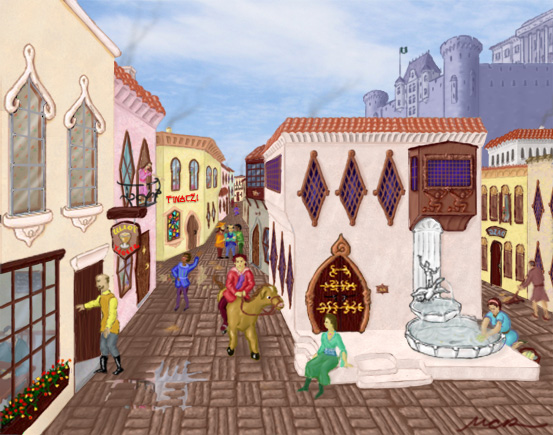
Or more prosaically, how did Eretaldans themselves travel in this period?
The bulk of this page focuses on the kingdom of Verduria. Though some of the advice is true of all early modern societies, places like Xurno or the Bé would require an entirely different document. However, I’ve added (incomplete) notes discussing differences in Kebri, Ismahi, and Barakhún.
I sometimes mention how things were different in earlier times, but this isn’t a full guide to travel in the Dark Years or Caďinas. And it’s no guide at all to the 3500s or 3600s.
For immediacy, and for consistency with the vast amount of material written with 3480 as the present, I’ve used the present tense. Hey, language is our servant, not our master. Also, if it’s not clear, I’m using “classical Verduria” to mean the 3240–3480 period, from Tomao to Alric.
Note: This page replaces and greatly expands the old “Visitor’s Guide to Verduria.” It was originally presented in December 2024 on my Patreon. —M.R.
The climate is subtropical: much like the southeastern US, or southern China. This means hot summers and fairly mild winters. There is more rain than in southern Europe, less than in northern Europe.
You’ll see things that don’t fit early industrial Europe at all.
In Verduria it’s the upper-class merchant (lescom) or trader (celdonec)… not your local grocer, but someone who’s amassed a fortune in manufacturing or continental trade. Verduria is an overgrown city-state, and this is how it generated its wealth and power. (I will sometimes use ‘burgher’ for this class, to distinguish them from nobles. I use ‘bourgeois’ for the urban middle class.)
A corollary is that Verdurian society is ordered for the benefit of the large-scale merchant or manufacturer. Laws and taxes favor them; making money justifies almost anything; and novelties are welcome if they increase trade or manufacturing. (It’s also, perhaps, the reason male primogeniture is not entrenched: for a commercial family, loyal family members are a resource not to be wasted.)
But wait, isn’t it the noble? But this is where Verdurian nobles come from; the only question is when the fortune was acquired: a decade ago, a century, or a millennium. It’s informative to look at the six nobles who sat in the first Biyetora (the council that chose Lords) a thousand years ago, in 2479, and the profession of their families:
It must be emphasized that there are exits, often precipitous ones, from the nobility. You can lose all your money due to dissipation or poor investments. You can fall afoul of the authorities— in dark times, by supporting the wrong ones. War, natural disaster, or economic crises can sink a struggling estate. Of the noble families named above, only the Sáluerî still have a title. (The modern Řomî stole the name.)
It may be useful to illustrate the vertiginous nature of the class system, by focusing simply on income, in falî (silver coins) per year.
(Caveats: Use as guidelines only, with common sense. Provide good ventilation and avoid open flames. For any profession, there is a wide range— consider these figures medians. The basic wage is full-time employment: one can go lower, much lower. Also, I use falî because I discuss all prices that way; Verdurians would use ořî.)
Top burghers 400,000 Dukes, princes 150,000 State ministers 50,000 Professionals serving the elite 20,000 Craft master, stewards, spies 8000 Lower officers, accountants 2500 Popular musicians, writers 1000 Craft workers 700 Basic wage 450
Americans don’t like classes; the CEO may well insist you call him by his first name. Medieval Verduria was the opposite: everyone knew their place, and bad things would happen if you didn’t behave with utmost deference to the elite. In classical Verduria, mores are somewhere in between, but at different points on the continuum depending on context.
Kebri is broadly similar, but has no rank distinction among its nobles (linna), and it has a strong separation between nobles in the countryside and burghers in the cities— neither is supposed to interfere with the others. Ismahi has the same classes, but has no real politics: state power is weak, but is held entirely by the king, without involvement from the nobles.
Travel is, in a word, for the well-off. It can include pilgrims, merchants, ambassadors, spies, nobles or bourgeois seeking entertainment or education. Most people can’t afford to take the months off it would take to get very far from where they work and live.
As a corollary, the infrastructure of travel— horses, carriages, taverns, inns— is expensive. Note that the daily wage is 1.5 falî, while daily travel costs average 8 to 10 falî per day.
The good news, though, is that there is a travel infrastructure— places to stay and eat, people accustomed to dealing with strangers and their odd accents.
There’s also migration: students traveling to university, workers seeking jobs, itinerant craftsmen or peddlers or scammers. As we’ll see, they have a much rougher infrastructure of their own.
Let’s suppose you want to go from Cerei to Verduria-city: 900 km.
If you have a horse, It’s plain sailing, so to speak. A professional courier, riding specially bred and trained horses in stages, can attain 300 km per day. The Caďinorians had such a system, and could send a horse that 900 km distance in four days. Only the emperor and top generals could use this system. Now maybe you can appreciate why the Caďinorian capital was in the center of Eretald.
If you own just one horse— and congratulations, that means you’re a person of means— it can’t go that fast, and not for days on end. 40 km a day at a walk; let’s say 50 if you have it trot or canter at times. That works out to 18 to 23 days for the trip.
The well-off prefer a carriage (sadoš), their own or a rented one. The latter will change horses each night. The horses were worked hard and managed 100 km a day; thus the trip could be done in 9 to 10 days, for a total cost of 30 falî. From Žésifo to Verduria-city you could take advantage of night service, making the trip in under a week, arriving exhausted and 80 falî lighter. (Night service was more expensive because it was more dangerous.)
What if you walk? If you’re in good shape, you can match the speed of a marching army: 30 km per day. That’s 30 days. The Bhöɣetan empires, which had no horses, had messengers who could make the distance in 5 days, running in relay. But no one in Eretald has bothered with such things, since horses exist.
If you place a raft in the Svetla in Cerei and let it float downriver, you will move at an average of 5 kph (3 mph). That 900-km trip will take 12.5 days. You could do this if you have a buddy and sleep in shifts— and can somehow keep your raft out of the way of the other river traffic.
Better, hire a boat. Most don’t travel at night, and make longer stops at the major cities to pick up more cargo or passengers, so expect the whole trip to take close to a month.
What about the trip back, going against the current? One way is to have your boat or barge towed by horses or oxen. These are going to be chunky but slow animals, and you’re looking at 30 to 45 days.
The other way is to use a sail. Except in the fall, the prevailing winds in Eretald come from the ocean, north to south: just what you need. A sailboat can travel at 10 to 18 km/h… on the other hand, the winds are more variable, and aren’t cooperative on east-west stretches of the river. So the trip could take anywhere from 3 to 6 weeks.
The route I’ve been considering is north-south, along a major river. What about east-west travel? This means crossing between river valleys, over hills, and of course can only be done on foot or by horse. Expect worse roads and slower travel. For trade, it’s easier and cheaper to ship your goods downriver, switch to the other river you want, and go upriver to your destination.
There is enough business that companies may schedule departures and even publicize day-by-day schedules. This was a marvel of novelty and efficiency to people of the 3420s. However, the schedules were rather aspirational: you could probably trust the departure day, but not much beyond it.
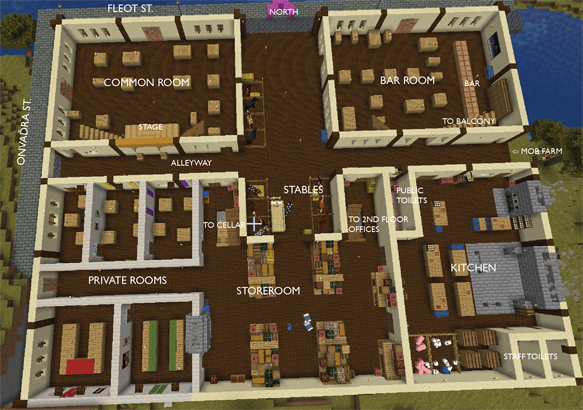 Cities and towns feature inns (prusî). These range from houses renting out a couple unused rooms, to big institutions taking up a whole city block. The price is nearly uniform in the kingdom: 2 falî per night.
In the humbler establishments, a room contains a straw mattress covered by blankets, and a pillow filled with rags or shells. In town you may get a clean private room with a soft bed, goose-down pillows, and comforters. If the inn is full you may have to share beds, or make do with blankets tossed on the floor somewhere.
Now the innkeeper has a logistics problem, and therefore so do you. Almost always you want to cover as much ground as possible during the day, and therefore you and everyone else are looking for rooms in the early evening. So there’s an evening rush, and places fill up. The innkeeper can’t afford to build for the largest crowd possible, so somebody gets downgraded. You might or might not get a discount for this.
It’s first-come first-served… until a person of quality arrives, and takes the best room in the inn. The only consolation is that they’re probably paying double or more. Also that this is fairly rare: the well-off stay with their peers if possible. Besides, they rarely travel alone, so only a very large inn will be able to accommodate them.
The innkeeper is your basic liaison to the surrounding area: they know where everything is and how to get it, whether it’s food, directions, tickets for Kusire’s latest play, or a mercenary.
By laws going back to Caďinorian times, inns are required to make up losses from theft. This encourages them to make their inns extremely safe, usually by hiring quant. suff. of big burly men. However, to make use of this, you must leave your valuables with the innkeeper. (Or show them to him, then add another fale so a burly guy gets positioned outside your door.) A recent, controversial innovation is the room key. Large inns, like Verduria’s Corona, offer lockable rooms to reduce the busywork of safeguarding valuables, and to offer guests more privacy and control. Not everyone liked this, because they had to keep track of the key, and because (say) having your key stolen was hard to prove.
A noble usually maintains a house in the capital in addition to his own estate. It wouldn’t be empty— very likely a relative lives there.
Due to the excruciating travel times, visits are long-lasting: weeks or months. There is of course a social protocol for this. A guest acts as part of the household— eating meals with the family, attending social events— but can pursue their own interests and friendships.
Modern terrestrials may be surprised at the lack of privacy. Even in a middle class house, people don’t have rooms of their own; and a rich person is often surrounded by relatives, friends, and servants. On the other hand, you don’t have to participate in the general conversation: you can read or write at a desk, or read, ignoring everyone around you.
Notionally people put up their friends or relatives out of pure love, expecting no recompense. Reciprocity is expected, of course. But there are things the guest could do to make their stay less burdensome: bring gifts, tip the servants, offer services or entertainment. It’d help if you can tutor the children, catalog the library, copy family manuscripts, take over a flower bed, watch over a sick or elderly family member, take care of some business in the provincial capital. (See also the section on servants, below.)
There are also signals that the host is getting sick of a too-extended visit; e.g. they ask you to move to a smaller and more remote room, or start asking about the next stage of your travels.
In middle to upper class houses, if you are not family and not a regular visitor, you hand the servant at the door your card (čunima). This contains your name, your title if any, and your profession if highly respectable. If you’re lucky, the servant disappears, then returns to let you in. Otherwise, you have to carefully parse how the servant describes their master or mistress:
On a more proletarian level, non-elite hosts are not shy about asking for help around the house, or asking directly for money. (Oh, and you never offer them your card, not least because you will discomfit them if they can’t read.)
See the next section for asking for lodging or food from strangers.
Upper-class pilgrims will travel as they normally do, unless there is some idea of penitence to their particular pilgrimage.
Monks often travel, either on pilgrimages themselves, or to study books they don’t have at home, or study with illustrious teachers. Monasteries, both Eleďe and pagan, generally welcome these, and treat them like their own members— which includes all the onerous schedules and restrictions of their order. If they work or beg, the visitor will do so as well.
If possible you’d choose an institution matching your own belief system. However, there’s a sort of professional courtesy among monastics, especially in remoter regions: an Eleďe monk may stay at a pagan monastery, or vice versa. Like any guest they are expected to join in the teachings or rituals, but they are not expected to repeat the liturgy or praise gods they don’t believe in.
You might ask, can I sleep at a temple or church? No, they are not built as lodgings, and it’s considered disrespectful to the deity. The one exception is that someone fleeing people trying to kill them, including the authorities, may take refuge at a temple or church, if the priests allow it. If you try it, you had better have a good story (merely seeing suspicious people is not enough), and get the priests or the public on your side so they are willing to feed you.
It’s extremely frowned upon to kill someone in a church or temple, so the person claiming sanctuary is safe for awhile. In practice, claiming sanctuary (ubreza) is chance to calm things down and make enquiries. (The person claiming sanctuary is allowed to talk, at least.) If it’s the authorities who are after them, they won’t send soldiers in… but if they’re really serious and public opinion is not dangerously against them, they might seal the building, not allowing either clerics, worshipers, or the alleged perp to enter or leave.
You might get a better reception as a pilgrim— it’s a meritorious act to assist pilgrims. Can you fake it? It’s a staple of fiction, and probably every criminal or beggar has tried it. But pilgrims are expected to act the part, and can be turned away if they seem suspicious. And be aware that religion doesn’t require that you coddle pilgrims— letting them stay in the barn is enough.
For members of minority religions, there is a sort of continental fellowship. The Arašeî were famous for this, in some quarters notorious: they could travel to an unknown town and stay with their local co-religionists. Followers of Irreanism or Endajué, or minor Caďin cults, can do the same today.
To a lesser extent, ethnic groups can do this too. In major towns there are likely to be Ismaîn, Barakhinei, and Téllinorese neighborhoods or streets. If you’re a migrant, you naturally go there, hopefully to meet a relative, but if not to make friends and contacts.
Traditionally the elcari fit into this category. They would load up a wagon with manufactures, then travel around Eretald, selling them and also doing metalwork in areas that couldn’t support a full-time smith. As discussed elsewhere, this became less profitable when human machines became competitive with elcarin ones.
Many of these people were not so much travelers as itinerant workers— but I mention this class of people because, if they needed to or wanted to, they could get from point A to point B this way, without a large store of cash.
If you do, you had better look so piteous that bandits leave you alone. But you can still expect hassle. Land belongs to someone, and that someone doesn’t like to discover unkempt people sleeping on it and probably leaving a mess. Maybe you can appeal to their benevolence— but contrary to the old adage, in this area it’s better to ask permission than forgiveness. Most people will be content to simply move you along, but a few have harsher ways of suggesting you don’t do it again, especially if you look able to work.
Are there many homeless people in Verduria? Yes and no. A premodern society is at the edge of subsistence— which means that one bad harvest, a flood, or an economic downturn can ruin tens of thousands. And there are always beggars in the cities, and people migrating through the countryside, equally satisfied to find work or handouts.
The lives of the poor are not long, and in bad times very short. As a comparison point, life expectancy at birth didn't rise above 40 years in Britain until the last half of the 1800s. Child mortality was high— if you made it to 20, you could expect another 40 years of life. It’s about the same in Eretald.
On the other hand, most people have family ties to someone more prosperous. You can’t really turn your cousin away, and it’s highly disapproved of to leave your second cousin homeless. And in a premodern society, these people mostly live nearby and you know them pretty well. In general people migrate only when a disaster undermines entire families or regions.
There is some pressure on the elite to keep people from starving. Under both Caďinorian and Verdurian law, nobles cannot kick peasants from their land— and it’s unwise to let the local peasants starve, as they directly support the estate in good times. The noble will attempt to relieve their distress if he can— though of course taking a hard line on peasants leaking from others’ estates. Historically starving peasants easily turned into bandits or rebels, and it is in nobles’ interests to prevent that.
However, the nobles— and to some extent the peasant— only prioritize the survival of adults. Everyone expects— because this is the way the world has been for millennia— that in bad times young children and feeble oldsters will die. Note, this grim picture applies only to the worst of times. Most years, there is enough bread to eat— indeed, people eat amazing amounts of bread, more than we would find palatable. It also helps that wars within Eretald are rare. But bad years will certainly come in everyone’s lifetime.
People prefer urban to rural poverty, so there is a constant trickle of migrants to the towns and cities. This is not a new phenomenon; cities are age-old generators of wealth, and in Caďinorian times cities had their own rural estates, and distributed the produce at low cost. The market now provides food, and indeed one driver of rural distress is that the cities can pay a higher price than countrydwellers.
In Verduria-city, Queen Onvaďra instituted a small welfare fund, the colapreca mažtanë (‘city assistance’), to help sustain the poor. People call it the colep after a type of fish, and the recipients colepomî. The Caďin party hates it, but they only had power for brief periods in the 3400s and have never had the votes to get rid of it.
There is an income requirement for voting— but Queen Elena reduced it in the 3200s to give herself a parliamentary majority, and inflation has reduced it further. That means that both peasants and the urban poor, though not the underclass, can vote. In the classical period this still means choosing from elite candidates, but a government which mistreats the poor will soon be thrown out. As prime minister Abend Monteneon noted to his successors, “Commiserate, if you like, with the manufacturer about the price of labor; but do not agree to do anything about it. Those wages are your parliamentary majority.”
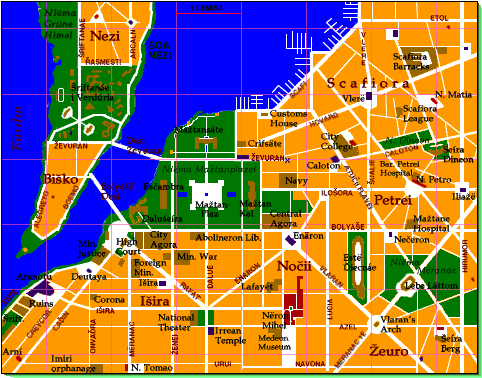 I’ve talked about how you travel; what about knowing where to go?
Travel books had always been popular, and could retain their popularity for centuries, which meant that they could tell you the historical tourist spots, but nothing about current conditions. For instance:
In 3431 Varďolo Doliney produced a booklet, Colaprec fayul Dolineii veturecin er vaglädecin (Doliney’s Essential Helper for Travelers and Pilgrims) giving descriptions and addresses of inns and other travel services, as well as regional maps. A new one appeared each year, though information on particular cities might be checked on a longer schedule. This was a huge hit, and the savvy gentleman buys a Doliney before traveling.
In the 3400s you can buy very good fold-out maps of Eretald in any bookstore. However, the savvy gentleman rarely buys one: most travel directions amount to “follow such-and-such road or river.” Towns are another matter. The Caďinorians liked street grids, but this habit was lost in the Dark Years: most Eretaldan cities are formless and easy to get lost in. You can hire a guide or an urchin at the city gates, or get a map. The best maps are produced by the Postal Service, but they’re not updated more than once every ten years or so.
The Postal Service (soa naždenë) was designed for use by the government, and the elite is also allowed to use it. If you know someone with access, you can ask them to send a message. But the non-elite generally have to hire their own messengers— in our period these are established businesses. The naždenë can deliver a message anywhere in the kingdom in four or five days (note, that is normally much less than the 900 km journey discussed ealier); private services take a few days longer.
Addresses are written from general to specific. A full address looks like this:
Verdúria-mažtanaFor a smaller town, you can leave out the neighborhood; but you’d supply the province.
Išira
37, Prosia Fleot
Prusi Frédrotei
Frédrot Sevney
Since the late 3300s, houses have been numbered west to east and south to north. Numbers skip from one side of the street to the other. If a house is subdivided, you get addresses like 37 ftore (‘second 37’).
The Postal Service will in theory deliver to anyone— but they don’t consider it their job to keep track of the growth of the city or the constantly moving poor. Indeed, new streets may not be numbered yet. Therefore if you’re mailing to someone working class or below, it’s best to send it to a local landmark, such as an inn or tavern, or a school or temple, or to a relative in a better part of town. If you don’t know that the recipient checks such places, you’ll have to hire a messenger willing to track them down.
Legally every owner is supposed to mark their street number in some way, but many don’t bother. Businesses usually do, however.
Street names may change over their length. That won’t surprise you, but there are sections of road where people don’t agree what street it is.
Even with a map, navigating a city is a challenge, because street signs are rare. One exception is the Išira district in Verduria-city: there are number of foreign embassies there, so the city put up signs for their benefit. Businesses, with an eye on repeat customers, will sometimes add the street name to their number plaque.
What you will find is signposts. Along major routes they point to the cities ahead; within towns they point to landmarks. It’s illegal to add your own pointer to the official markers; but businesses can put up their own signposts (if the property owner agrees)— or just add an indicator as graffiti. One of Abend Monteneon’s canny moves, when he acquired the Corona Inn, was to place signposts pointing to it all over the city.
In Kebri all streets are labeled and all houses must have visible numbers. Anyone can use the Kriidi (the postal service). The typical pilgrimage involves visits to various nahra (holy places), which are often in out-of-the-way spots; this generally involves hiring a guide or buying a guidebook with maps.Syxesteer is famous for color-coding its main roads, e.g. blue for the street along the oceanside. Addresses are often schematic: “East on blue, north on red; 4th block east, 17th door on left.”
 For a full discussion of food in Eretald, see the Let’s Eat! series on my Patreon. This is only a summary. (Be aware that the intercontinental cuisine described there only existed in the 3600s. In the classical period you could only get Nanese or Siadese food by going to those countries, and a Xurnese style meal was considered exotic.)
If you’re from Earth, Almean food will seem familiar but slightly off, just as “Chinese broccoli” (jièlán) isn’t the same as European broccoli. Did you know— and we may be getting into pet peeve territory— some people call cilantro/coriander “Chinese parsley”? It isn’t anything like parsley!
I could use Verdurian terms for everything and carefully describe the differences— but that gets tedious, so instead I use close equivalents if they exist. Also see the Almeopedia which provides extended descriptions of common crops. Just don’t complain that things don’t taste the same as on Earth. Travel is supposed to be broadening.
Given all that, Eretaldan food is not unlike European food. There is no chile pepper in this period, and nothing like a tomato, but the potato and maize are known. Black pepper is rare. (It comes from Dhekhnam, and only the Kebreni will go there to buy it.) Coffee and tea, sugar and chocolate and peanuts were introduced in the last centuries, but are thoroughly integrated into Eretaldan cuisine. Verdurians take their coffee with sugar, Kebreni without.
Verduria is known for the zer, a flat bread which ranges from tortilla to pita to nan in texture. It can be made open-face, but typically you roll up other ingredients in it: meat, veggies, cheese, even some rice or potatoes. It’s the food of the commoners, partly since it can be eaten on the go, partly because it’s an excellent way to stretch your meat. You usually buy them from street vendors or make your own.
At a restaurant, you get pasta (maco) and plenty of it, with a buttery sauce and Aodo cheese to grate on top. It can and probably will be mixed in with ham. In fact you will get ham everywhere— as sliced slabs, as cubes wrapped in zerî, as minced bits on top of your salad or soup. If you want to start an argument, ask which is better, Célenor or Šerian ham. At a noble’s table, however, you’re more likely to find beef or whatever game the host has hunted lately.
Verduria is also known for extremely heavy soups. It’s a great way to use things you might not eat otherwise, like turnips or kidneys. I should probably warn the earthly traveler that Verdurians consider betra to be good eating. A betra is a female dog.
As the Let’s Eat! series explains, fine cuisine depends on sauces. The typical Verdurian sauce is a thick gravy, made from pan reductions combined with flour and butter. You can add milk or cream, onions, mustard, and herbs. In Kebri you get olive oil and lemon rather than flour, and in Ismahi, eggs with wine or vinegar. A daring chef will create a Xurnese sauce, with potato starch.
Dessert runs to puddings and custards. No ice cream in this pre-freezer era. The Ismaîn table will sometimes serve it, though, as the noble has an icebox and can have ice fetched from the mountains.
Verdurians have a choice of alcoholic beverages: beer, wine, or mead. Beer is cheaper, thus more popular with the people; the noble serves only wine. Verdurians say that beer, wine, and mead are for the strong, the smart, and the crazy, respectively. Mead (which is based on honey) does take some getting used to. For serious drinking you turn to distilled liquor.
Not a drinker? The water is probably questionable, which is one reason boiled beverages like tea and coffee are popular. There’s always milk or fruit juice, but if you’re at all prone to stomach upset, make sure you see it produced directly from the cow or fruit.
Inns generally offer food, at a common table, and you get whatever the cook feels like making. No, they won’t make a vegan version for you.
Institutions often have common dining halls; from the 3200s there have been private clubs (lesteoi) which provided places for their members to meet, relax, play games, and eat. These were often segregated by sex, religion, and effectively class: excluded from an upper-class club, a guild or group of craftsmen could set up their own. In the 3300s many clubs opened their doors to the public, and lesteo became the word for ‘restaurant’. Private clubs still exist, but became known as rëcnáî.
Clubs and restaurants both offer a menu of meals, but a very short one. In a pre-refrigeration era, only right at the docks, where fresh fish are constantly available, is there a wide choice of meat. Restaurants naturally prefer meats that last awhile, like ham or sausage, plus whatever fresh vegetables arrived in the city this morning. A restaurant may keep a coop of chickens, both for meat and for fresh eggs.
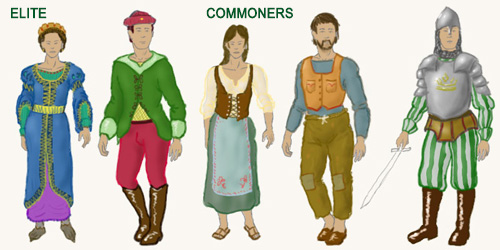
If you’re terrestrial, nothing in your closet will do, unless you do Renaissance cosplay. On the other hand, Verdurian clothing does look vaguely European: skirts or dresses for the women, jackets and trousers for the men.
A poor woman generally wears a long woolen skirt and a light linen blouse; her husband wears trousers of wool or hemp, and a cotton shirt. Both sexes wear a leather vest (sambrake), fastened with buttons or laces.
The elite wear much fancier versions of the same things, made of more expensive materials such as silk or velvet. In place of the vest they wear a jacket: a short one (pauto) for men, a long one (sutana) for women. Expensive decoration is always in fashion: embroidery, lace, ruffles, ribbons, slits showing the costly materials beneath.
Styles do change, but if you buy or inherit a fancy outfit when you marry, you will keep wearing it your whole life. Only the ultra-rich worry that an outfit is not appropriate for this decade.
Elite clothing is colorful and elegant for both sexes, and both men and women wear jewelry. There is no idea that men’s clothing should be drab or monochrome, or that men should not be interested in fashion. Men’s trousers are tight, and men rather pride themselves on having a shapely leg… perhaps because legs tend to look better later in life than stomachs.
Underneath you wear a linen lanika or slip, which may or may not be joined between the legs. Men’s are shorter than women’s. Upper-class women wear a band (bres) that constrains the breasts somewhat. (Almean women are rarely chesty.)
What did women do about menstruation (ilëgárda)? It’s worth noting that menstruation came a bit later— 14 to 16 years, the lower figures applying to the better-fed elite— and menopause earlier than in modern times; also that women spent a lot of time pregnant or breastfeeding, thus not menstruating. Anyway, the usual expedient is rags (kirek), pinned to the lanika or wrapped around a stick and placed in the vagina.
As in Western culture, it’s much more acceptable for women to wear male clothing than vice versa. Women wear pants in Xurno, so imported Xurnese pants, or imitations, are well known. In some professions men and women wear robes, which derive from medieval and Caďinorian clothing.
Both fancy and ragged clothing will draw extra attention. Eretaldans are not devoid of pity, but their attitude toward the truly destitute is that they should go be that somewhere else, not in their shop or outside its door.
By terrestrial standards Verdurian clothing is modest— you’ll rarely see a female knee, shoulder, or midriff in public. The poor may breast-feed anywhere, but you won’t see the bourgeois and elite doing so.
On the other hand, Verdurians and other Eretaldans love bathing, and do it once a day if they can. A middle class or higher home will have a bathing pool, where the family will relax after washing themselves. The poor may go to public baths (onela, which are segregated by sex) or use the river.
You may wonder how bathing protocol applies to guests and remoter family members. The answer is that mixed bathing is acceptable only for the immediate family. (Thus, you will know what your siblings look like naked, but not your cousins.) Guests can use the pool, but only with members of their own sex. In a large house, servants have their own facilities; in a small one, they can bathe when the family is asleep.
Laundry is a headache. There are no washing machines; washing is tedious manual work, which requires access to clean water and soap; then there's the hassle of air-drying. Inns offer laundry service for a fee, or you can visit a falis, a laundry. No wonder that for short trips people do without, figuring that cleaning their bodies is enough. Eretaldan noses are strong. However, the savvy traveler will at least bring changes of shirts and lanika.
Kebri has kept its variation of the robe (oraigu) for both sexes, though a shirt + kilt combination is also found. Women’s oraigu are tighter and often brighter in color. The upper classes would blush to wear anything but silk. As the weather is a bit warmer, lower-class outfits are likely to be sleeveless.
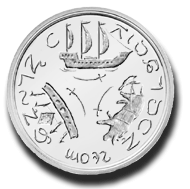 Off-planet visitors are advised to bring pure silver or gold, which can be sold for local currency.
For simplicity I’ve stated prices in silver falî, but of course there are more coins than that. Here’s a table showing names, sizes, composition, relative values, and a rough value in dollars, for the kingdom of Verduria. (Note: I’ve doubled the dollars from the figures found on earlier pages, as they were written 30 years ago!)
Emur is an alloy of silver (21%) and tin (79%). The ‘silver’ coins have 10% tin.
oř 3.3 cm gold = 3 ořulî = 12 f $116 ořula 1.9 cm gold = 4 falî = 4 f $28 fale 3.3 cm silver = 3 aržentulî = 1 f $9.60 aržentul 1.9 cm silver = 4 emurî = 1/3 f $3.20 emura 1.9 cm silver + tin = 6 stanî = 1/12 f $0.80 stan 3.3 cm tin = 1/72 f $0.14
The relative value of gold and silver, and that of silver and tin, vary depending on the global supply of metals. Most cash transactions only involve the silver and tin coins, and most people don’t worry about the silver-tin ratio.
The 12 to 1 gold-silver ratio applies broadly to the 3400s. Now, suppose the actual value of gold this year is 12.25 times that of silver— what does that do? You want to buy a fine robe for 84 falî, which is 7 ořî. But the gold is presently worth 85.75 falî. Do you ask for a discount? The discrepancy is worth a day’s wage. If the ratio was 11.75 instead, your gold would only be worth 82.25 falî— the merchant will certainly be aware of this and demand an extra 1.75 falî.
If the discrepancy is much less— e.g. if it amounts to a few stanî— it may be ignored. Gold tends to be used only for large transactions, where everyone is pretty scrupulous and aware of the current ratio.
A more common problem is the use of foreign currency. Verdurian falî, Kebreni alať, and flaidish meckiner are accepted almost anywhere, but states normally require that only their own coins be used. (Merchants don’t know two dozen possible currencies and have no desire to keep up with whether the currencies of Cerei or Curiya have been debased.) Moneychangers and banks will change coins for local currency for a fee. (It’s always 12.5% in Verduria-city.)
Countries in Eretald have experimented with paper currency (denkuna) but it’s considered a failure. It worked more like bonds than coins: you bought a note with the idea that it would be redeemed later with interest. But smaller kingdoms often couldn’t redeem them, and the last time they were used in Verduria— during the wars with Kebri in the 3200s— you could only redeem them for more paper notes, and merchants eventually refused to accept them. They are however used in Flora and Kebri, which have far more trustworthy treasuries.
For very large transactions, the elite will use a bank draft (zetdeče). These work much like checks, but with more bureaucracy. You get a booklet of zetdečî at your bank, and sign each one before you leave. They are engraved, which is harder to counterfeit.
The general procedure:
In general the recipient can’t sign the zetdeče over to a third party. The exception is that you can have a standing agreement with a broker or moneychanger to handle zetdečî made out to you. The advantage is that the moneylender is willing to immediately transfer the funds to someone else. Among other uses, this allows the careless gambler, who has a zetdeče from someone else, to use it immediately to keep betting. A large gambling establishment may have agents from several moneylenders at hand, or easily called in, for just this purpose.
(But that’s the lowest level of service. A personal valet or lady’s maid may get 4 to 5 falî per day; and for the elite, prices soar. A steward who runs an entire noble estate, as one data point, costs 60 falî per day; a personal secretary, who will travel with you and take care of every detail, about 25.)
How do you find them? Ideally, by word of mouth. A good servant travels on a sea of recommendations. You can advertise in the papers, though only for the more expensive type of servant— one who can read. Existing servants can recommend a friend or relative. A savvy noble knows the heads of the families who live in his estate, and they will be happy to suggest someone. Candidates will also suggest themselves. The local temple, or a popular tavern, may have notices from people looking for work. You want to be wary of the man who sidles up to you at the tavern and turns out to need a job. (See the section on Scams.) At the least, ask the innkeeper or other locals if they know the man.
How are servants treated? It varies: there can be real affection and care for longstanding servants, but also abusive situations. It may be worthwhile to review how many Americans treat household help, as well as restaurant staff, as opposed to employees at their business: with a maximum of entitlement and annoyed condescension. Verdurians are no better. Though they’re often paid less than anyone else, the householder seems offended if the servant expects to have any private time, or has any personal needs at all. Manuals of etiquette, as well as memoirs of the elite, have to remind their readers that it’s not a wise idea to mistreat people who live in your house, know where the valuables are, and are possibly in charge of your food, your children, or your very body.
The exception is the better-paid servants, or the ones which have been around forever, perhaps since before you were born. You don’t abuse your personal valet, your steward, or your master chef.
Are servants servile and submissive? Well, there are literary depictions of such behavior, and pious admonitions to emulate it— but also many complaints about servants being cheeky (iräme). In comic plays, servants are generally portrayed as gossipy, uninhibited, and selfish— though here too we have to be careful; the plays weren’t written by servants. From all we know, servants did their work but also spoke freely and pursued their own interests, such as getting drunk and/or making it with the other servants.
Some workers did offer the sort of dignified deference the elite expected… because they were paid extra for it. The 1 fale a day servant might be rude or lazy; the 4 falî a day servant, the middle class clerk, the barkeeper or hustler angling for extra coins, was willing to play the role of humble servant.
There is a category of people who live in one’s house but who are neither servants, professional employees, or close relatives. The general term is utekecî ‘those who stand near’. Remote relatives or long-term guests may fall in this category. These people may be treated as part of the household and addressed with formal pronouns, but as it’s clear that they have no other real livelihood, they are also not equals, and are expected to be helpful. They may well turn into traveling companions as well.
In Verduria and the littoral, slavery is outlawed and considered barbaric. The Caďinorians had a horror of it, having been been treated as slaves by Munkhâsh; but it crept back into Eretald during the Dark Years, mostly for criminals and war captives. It was outlawed in Verduria in the 3200s, and in most countries of Eretald thereafter, but you can find it in remote countries like Barakhún and Dracnáe. In none of these areas was it ever of great economic importance, even at the level of ancient Greece or Rome; it was more an extreme form of servanthood, as in ancient Mesopotamia or China.
A pilgrimage generally has a specific purpose:
In the classical period, people do no real archeology, which means they are limited to ruins which are still visible; also that their information about what they are looking at is limited. (In the 3500s many a ‘shrine’ or ‘imperial palace’ was discovered to be a theater, a court, a private mansion, or even a barracks.) No one is yet digging up the countryside to find minor shrines or forgotten cities. Visible sites are plentiful in Ctésifon and Svetla, and the ruins of places like Eleisa, Aites, and Erruk are well known. But parts of both Eleisa and Erruk have not been excavated, and people often think the ancient cities were far smaller than they were.
The elite often send young men on what is supposed to be an educational tour, which is often a chance to indulge in sensory pleasures far enough from home that they won’t embarrass the family. The ostensible idea might be to study, to meet far-flung relatives, or to learn another language.
The University of Verduria is well known for sending home students who don’t bother to study, which is why the more dissolute nobles have degrees from provincial universities. It used to be that they would at least learn Caďinor, but these days one can get by without that august but difficult language.
Non-Verdurian elites take the educational function a little more seriously: the young man had better come back knowing Verdurian, at least. Even better is if they can pick up, somehow, whatever it is that makes Verdurian society richer and more dynamic than Barakhinei or Svetlan or Ismaîn. This is a tall order, but they may at least make some business contacts.
On a higher level, scholars do travel to meet each other, to study with the better professors, to consult specialized libraries. Very occasionally, they travel to do experiments: e.g. the chemist Sevasto Eilonuy traveled to the mountains of Ismahi to investigate the properties of materials at or below the freezing point.
Explorers are mostly wandering places like the Rau savannah, the Nanese jungle, Téllinor, and the fascinatingly obscure continent of Arcél. A few Kebreni take advantage of their relations with Dhekhnam to explore that country. But in this period you could still get a book out of a long stay in Barakhún, Flora, Caizura, Obenzaya, or Elkarinor.
There is a minor but important degree of medical tourism. Sometimes this is because the treatment is supposed to be better: physicians are a little more careful and knowledgeable in Verduria-city. But often it’s a matter of rest and climate. You might go south in the summer for the cooler climate, or visit well reputed hot springs or Kebreni lakes. The mountains are supposedly good for tuberculosis. And of course if there’s an epidemic going around, the elite will escape to the countryside.
Travel for culture or entertainment will be included in the next section.
Kebri is famous or notorious for the eklurei, a place of pleasures. You can eat and drink there while enjoying performances of plays, music, dance, or stripteases, and there’s a back room for gambling. As a proverb has it, eklurei ziunte, zaurte eśu, what happens in the eklurei doesn’t exist. In general you can indulge any sin in Kebri so long as you do it discreetly. It’s mildly scandalous if you’re seen entering an eklurei, but any accounts of what you do there are assumed to be unreliable. The performers (m. kamateu, f. kamatec) may be flirtatious and underdressed, but would be insulted to be called prostitutes (maḣeu/maḣec). But they may well get on very well with a customer, and customers like to be generous.
Some notes on specific activities follow. These are by no means exhaustive!
 This includes drama, poetry, readings, music, and dance. For most of this, of course, you’ll need a command of the spoken language.
There’s a lot more of these things than you might expect. In modern terrestrial societies, going to a play is something of an elite experience. But there’s no TV or movies in classical Eretald, so plays are the primary medium for spectacle and storytelling.
E.g. tickets to a play cost 4 emurî, i.e. ¼ fale— about the cost of a loaf or bread or a bottle of wine. You might get in for 2 emurî if the crowd is thin, or if the theater has a standing-room-only balcony. There’s no charge at all for plays performed at religious festivals (and these are by no means dry or sanctimonious, they’re designed to appeal to the masses). In the countryside, traveling troupes may put on a play for even less.
(There’s a lot more to say about theater in particular— I’ll cover that in another document.)
There are professionals in all these media, and even celebrities. But far more than in a modern society, people are used to providing their own entertainment. It was common for everyone in a bourgeois family to learn an instrument, and even in a small village some people would play fiddle, flute, or drums. And of course everyone could sing or dance.
The major exception was religious and civic decoration. You could, in fact, view hundreds of sculptures, and quite a few paintings, by walking in and around temples and government buildings. Your Doliney would even point you to the finest works. The majority were from the last two centuries or so, but a large number dated from the early kingdom, or even from Caďinorian times.
The idea of a museum (taläte) is relatively new. In 3418 the Medeon family created the Medeon Museum in the Nočii neighborhood, to display their extensive collection of Eretaldan artifacts going back to Meťaiun times. There’s a smaller museum at the University of Verduria, and the Tevorad Museum in Žésifo dates to the 3300s.
Also relatively new is the art gallery (ontnáe). Traditionally painters and sculptors were craftsmen, and their workshops would display at least a few works. The market for art is now large enough that galleries have appeared— in theory, at least, they find and represent the best artists. Some are private, but most allow the public in, if they don’t look destitute. Naturally these are found only in posh neighborhoods such as the Biško.
There was one more outlet for indulging one’s curiosity: books and journals. Since the invention of printing, it’s been possible to make pictures of private artworks and distribute them widely. Nobles might even subsidize an illustrated catalog of the works on their estate— this was the early stock in trade of the Zeirey printing family, who later founded the Sanno Lebë newspaper. Most of these are black-and-white engravings, but there are also editions in color.
Finally, I’d note that in a pre-photography era, people learn to sketch and are pretty good at it.
Xurno, at this time, is governed by artists of all sorts. That means, among other things, that a lot of visual art is produced, and much of it is displayed in some form to the public. The Xurnese embassy in Verduria even imports some of it and mounts exhibitions.
The most organized sport is horseracing, ďiec šualië (if you just say ďiec, horses are assumed). There are races every day at the Estë Ďiecnáe or Great Racetrack in Verduria-city, leading up to the culminating race every cuéndimar for the melastes tipel (best horse), a prize so lofty it had to be named in Caďinor. The horses are generally ridden by their owners, or someone in their family.
If you visit the Great Racetrack you’d might as well make a day of it; the day is likely to feature three horse races, some human races, a marching band, and other diversions, like trick riding, humans goading and evading bulls, or demonstrations of falconry. You can buy zerî and beer on the premises. Bring binoculars, if you can afford them.
Children have been kicking things around since forever, but boďpila (‘kickball’) derives from medieval Érenat, where it was organized, with set rules, as early as the 2600s.
In definta, literally ‘off the top’, the target is a pile (ošora) of rocks or blocks, and the goal is to knock the top one (the finta) off. You can’t toss the ball, only roll it. The bourgeois variant is to buy or make an ošora made of four or five metal disks graduated in size; you get more points if you knock more of them off the base.
Verdurians like to watch bouts of military combat, with swords, pikes, and crossbows. The general term is celäu, though technically that just refers to swordfighting. Unlike Caďinorian audiences, you are not likely to see actual blood and death. (Though accidents happen— it's not a safe sport.) The lowest level involves wooden swords and heavy coats; at the highest levels, blunted metal weapons and chain mail.
Now, actual military combat generally does not make for good entertainment, any more than pig-killing. The competitive bouts run till first touch; the fighters are carefully matched so that defensive skills (movement, parrying) can be displayed, drawing out the fight; and final blows are cheated. The top fighters are usually real soldiers or veterans, so the moves are authentic, more so than you’d find in stage combat; still, the participants and aficionados consider it more an art or a demonstration than real combat.
The public tends to prefer swordfights and demonstrations of mounted attack with the lance. (The aim of the latter is to knock the rider off his horse. The padded wooden ‘lance’ is designed not to cause serious injury, though it can leave quite a bruise.) There are also demonstrations of prowess with the bow or crossbow, bouts between pikemen, and mixed encounters such as pike vs. sword.
It’s awkward and not really socially acceptable to wear a sword while going about town; instead you take a rapier (čisy). Nobles often have a second career as cavalry officers, and thus master the cavalry saber (carďë), as well as the rapier. Bouts with the rapier are thus popular with the middle and upper classes. A rapier can hold its own against a short sword, but the masses don’t really believe that and prefer to watch swordfights.
In theater, actors sometimes wear, under their cloth armor, some sort of bladder with animal blood inside— or anything viscous and red. If all goes well this produces a satisfying burst of fake gore. Some promoters do the same for public demonstrations, but it’s considered tacky and you won’t see it in bouts held by the army.
In Barakhún, it’s not hard to run into something more dangerous, the trogêkerof or ‘touch-blood’. These are duels fought with the belak, which is heavier than a rapier but lighter than a sabre. The aim is to draw blood, ideally from the face or head. Participants wear eye protection (hikasi) and a chestplate. These days, a physician is at hand. A trogêkerof is not for settling disputes; it’s a display of stoic masculinity— an elite male feels like a noob until he has at least one scar. For aficionados, too elaborate a defense is bad form. So is getting drunk beforehand, though afterward it is required.A few countries, including Barakhún and Érenat, maintain the medieval idea of a citizen army. That mostly means that several times a year, the local lord holds a feast and the young men (and a few women) compete with bows or crossbows, races, and wrestling. Rural nobles will get together for competitions in horsemanship.
(As a reminder, the classical period is just before the rifle era, so all these weapons were still a military necessity. There were no major wars in the period, so not much pressure to adopt that eccentric Arcélian invention, the gun. But cannons had been in use for some centuries, which in turn meant that plate armor was no longer used.)
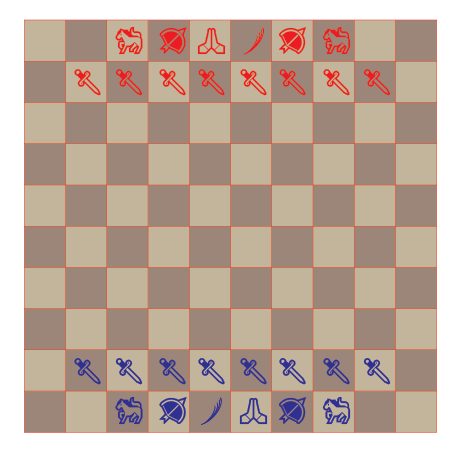
The best known board game is ecunî or knights-and-kings, which dates back to Cuzeian times and is similar to chess. The basic contemporary rules:
Ihano: Londrot, I think you have a gambling problem.Most people, to put it frankly, don’t have enough money to gamble much. They will play dice or card games for stanî (1/72 fale), sometimes buy a raffle ticket, make a little bet at the races. But as the proverb wisely says, Parir e pitir muánece, betting means drinking less.
Londrot: I’ll bet you half a fale I don’t.
The real lečec or gambling fiend is someone with money: middle class or higher. Gambling is one way to turn a large fortune into a small one. Or we may say, a form of redistribution, though the money doesn’t generally end up in hands that deserve it. Soldiers and sailors, who are provided room and board and whose pay therefore is all discretionary, are notorious for spending it all on drinking, gambling, and whoring.
For two millennia Eretaldans played cäselî (Caď. caucelit), using coins (or whatever small items were at hand). A player starts with five coins; all players put two of their coins into a pile, then take turns throwing a coin at the pile. The aim is to knock coins off (one point each), but not to scatter the whole pile, which is called a crash (peš) and ends the round with no points.
Almost no one plays straight cäselî any more, but rather one of its many variants. Prošë gečia (Next throw) is a remote variant played in gambling houses. A player declares a bet, then rolls a six-sided die. He can bet on his own throw or the next player’s, or he can bet nena (same), meaning his roll will be the same as the next player’s. Every second round, the house has the additional option suy (not), meaning they win if the next throw is not the same as theirs.
A more sophisticated variant is Dunisë prošë gečia (Double next throw), which uses two dice instead, but varies the payoff: less likely sums pay more. There is an additional betting option, pak (next to); e.g. pak 13 means you win if you roll 12 or 14.
There are dozens of card games; the fanciest has the curious name (šendu) Aráne ismaë, the Ismaîn Game of Aránicer. That’s because it’s a variant of Aráne, a game of Aránicer, which involved betting on the contents of one’s hand, much like poker. The Ismaîn variant dealt one card face up for all to see, and allowed players to be dealt a new card (discarding one) or to exchange cards (sight unseen) with another player.
Now, suppose you want to be a professional gambler. What do you do, besides cultivating a pencil-thin moustache and a tolerance for alcohol? You don’t bet on the games themselves, that’s for suckers. You bet with the onlookers or participants about their hunches. In the moment, people get excited about their systems, or notions that a number or card that hasn’t come up in awhile must be about to, and if you know the odds well, you will beat them more often than not.
As there is a lot of side-betting, and at racetracks people might not want to give up their seat to make a bet, a system of hand signals has developed to allow silent betting. In plays a nervous person is shown making and losing a bet with idle meaningless gestures, but this is satire. A bet requires firm eye contact, the gestures are fairly vigorous, and the bettor confirms by tapping the back of his hand with all five fingers of the other, miming placing coins on the table.
The pagans put on the best show. What can you expect in one of the larger temples?
An Eleďe service is more sedate, but also more focused on community. There will be readings from the Book of Eleď, a teaching, singing, and prayer, but also reports on community initiatives, and usually a communal meal. The appeal of Eleďát, in its early centuries, was more personal attention and a close-knit community.
Services are far stuffier for pagans in Žésifo, and for Eleďî in Érenat. But this is only scratching the surface of the diversity that exists.
In the premodern era, it was quite the reverse. The only safe place for the elite was the city— or their own estate if they had one. Both places were well guarded. In between, on the roads, you were constantly worried about bandits. The very name, bortom, tells a story about the dimensions of the problem: bort, a band or gang, comes from Caizu baort ‘forty (men)’.
That also indicated the size of a travel party needed to resist them. It’s notable that king Ževuran’s Great Code, which attempted to prohibit war among nobles, limited a noble’s armed escort to fifty men.
Now, bandits thrive in periods of lawlessness, and the 3400s are not that. Verduria-city, whose wealth and power arose from trade, was always concerned with the safety of the roads, and even in the Dark Years it took care to protect the road to Vyat. Bandit gangs are generally hunted down, and troops patrol the roads. If you stick to the major roads in the kingdom, or to the rivers, attacks are rare.
This isn’t to say caution is unnecessary. Pilgrims, merchants, and members of the elite prefer to travel in groups, bring their swords or bows, and hire some armed men of their own. You sleep at an inn, which has guards of its own, not out in the fields.
If bandits do accost your party, consider the old fake moneybag trick. Hide your money into your belt or sew it into your clothes; then have a purse available you can throw at the robbers. It has to have enough money inside to satisfy them. They know the trick too, so the real trick is the acting: sell the idea that this is really all you have and that it’s not necessary to strip-search the passengers to find their money.
Are cities really safe? Not absolutely, but they’re much more so if you have some street smarts. The single most tempting target for a criminal is a rich guy who is drunk, looks too weak to fight, and is outside his turf. Don’t bar-hop— if you mean to get drunk, do it in your inn and slip a coin to the innkeeper ahead of time so he keeps an eye on you. Don’t venture into bad neighborhoods wearing fine clothes, or without a strong friend. Don’t take your purse out of your pocket where it can be grabbed: if you must access it in public, slip your hand inside and extract what coins you need. Stick to main streets where there’s a crowd.
It may be worth remembering that the bad guys don’t have guns, though they may have crossbows. If you can, run like hell. Did you bring or buy a sword, to fit in? If you don’t know how to use it well, don’t even try. And if you do— also don’t try; it’s only in stories that an expert swordsman dispatches four or more thugs without receiving a scratch.
The type of out-and-out criminal you’re most likely to run into is not the robber but the pickpocket. It’s rather impressive to watch a gang at work: one person jostles the mark; another does the snatch while the victim is distracted, then throws the purse to a third person. Some travelers tie their purse to their clothing, but the general rule is not to carry more coins with you than you can afford to lose.
Most action against criminals, whether protection or punishment, is handled by private citizens: families, concerned merchants, borough associations. If you’re the victim of a crime, your first recourse is the head of your extended family. As attacking someone is attacking their entire family, this does discourage serious crime. (As a corollary, it’s far worse to be sanženate, without a family, than to be merely sampire, without parents.)
The merchants and the kešana (borough) have an interest in keeping the streets safe, and punishing miscreants if they can be identified. In some boroughs, like the Scafiora, the kešana authorities may be criminals themselves… but major ones, who do not want small fry going after the citizens and tourists.
Travelers of course may be far outside their network. But don’t worry, you can hire your own thug, either as a bodyguard or to go after a criminal. The success rate on the latter is likely to be low, so it’s not advisable to keep paying for more than a week of inquiries.
There are monastic orders dedicated to punishing evildoers, notably the Clek Enäronei (Fist of Enäron) or the all-female Knights of Dévora. They won’t be interested in pursuing a mugger, but they will pursue killers and rapists, at no cost to the client. Make sure to specify ahead of time whether you want the miscreant’s life preserved.
Serious unrest will be addressed by the military— but Verdurians do not really like soldiers, and start to feel oppressed if they see them marching in the streets. (They have a much more positive view of the Navy.) Government buildings are protected by the Palace Guard (Hežy Daluy). These may assist the ciluomî, but only for crimes committed within sight of their post.
Most of these will not be crooks; taking advantage of a gullible foreigner is not beneath the dignity of merchants, beggers, prostitutes, and guides. Expect to be quoted high prices in hopes you’ll accept them. If someone mentions special fees or taxes, they’re probably making them up. (Foreigners need only worry about the moneychanging tax.) If someone offers to show or sell you alchemy or magic, it’s a scam: actual wizards don’t hawk their skills on the street or in bars.
There are scams that involve selling fake merchandise, short-changing merchants, mixing up coins, making confusing bets, and the like, but the most lucrative scams are appeals to the mark’s greed. Example: for complicated but carefully explained reasons, a feeble-looking stranger entrusts you, a stranger, with a large sum of money. Only it's not right there, at least not all of it. There are complications, also carefully explained, but in the end you (and maybe other apparent bystanders) have to put up some of your own coins to overcome some obstacle. Once you’ve done that, the scammers and their ‘treasure’ disappear.
In general people don’t tip at inns, taverns, or restaurants— though the elite may distribute some coins if they want something extra, such as a private room, or just more attentive service. At a tavern, where you can pay for each drink as it comes, paying a little extra will ensure that the glasses are a little more full, and undiluted.
In Kebri, people will routinely buy each other drinks. If it’s people you know, this is rarely a problem, but you have to watch out for strangers, especially if they offer to treat you something expensive. You will be tempted to recriprocate, and end paying much more than you’d expect. Later, the stranger will collect a fee from the bartender.
First, you have traditional Caďinorian medicine. This is based on the seven elements, which each have associated temperaments, bodily fluids and substances, and diseases:
Physicians (lekaroi) attempt to determine what organs are dominant, then which may be too weak or too strong. Disorders normally come in pairs, e.g. a weak heart causes anemia, an overheated one causes strokes. Anything difficult to assign to a particular organ is assigned to endi and thus the liver; a skillful lekaro is said to oteran so hepatam, to intimately know the liver; that is, to understand what is most hidden.
ur clay practical sweat, mucus skin pox, leprosy, plague mey water benevolent fat stomach nausea, gout ďumë stone determined semen, egg genitals impotence, venereal disease endi wood quiet tears, urine liver malnutrition gent metal powerful muscle bone arthritis tšur fire bold blood heart stroke, anemia šalea air intellectual breath, nerves lungs headache, asthma
Treatments are heavily based on the metaphors of the elements, lacks and surfeits thereof, and the supposed bodily manifestations of all of these. Examples:
There is an idea that some environments are unhealthy— they are durnilî použî ‘malign locations’— but this is a matter of vibes more than, say, dirt. Graveyards and ruins are durnilî, for instance; so are both swamps and deserts. There is a biological reason for that last judgment: Almean humans cannot tolerate low humidity, one reason they try to bathe daily.
If you need surgery (trancát)— removing a tumor or a gangrenous leg, removing an arrow, stitching up a wound— the lekaro is at his best, which is to say, competent at the basics, less likely to kill you. The major worries are the risk of contamination, and the fact that the the only anesthetic known is staggering amounts of alcohol.
If you need to give birth, avoid surgeons, get a midwife (unesoma). These are women without formal training, but extensive experience with birthing, both normal or difficult. Almean women almost all give birth while squatting— lying down is for the convenience of doctors, not women.
(What if you need a Cesarean? Well, you’d better hope you don’t; the midwife can often facilitate deliveries where a terrestrial doctor would pull out the scalpel. There are cases where Almeans have performed a Cesarean and the woman lived, but the odds are not good.)
An alchemist (ceřecom) will offer cures, as well as lurid tales of the deficiencies of lekaroi. Alchemy starts with the same Caďinorian elements, but believes that they can be transmuted; also that the base elements are more powerful than mixed ones. That may be fine if they proscribe, say, an enema with pure water, or resting heated stones on your back; less so if they advocate mixing metal filings into your food, or setting fire to your hair. (They cut it off first, but it’s burned uncomfortably close to the body.) Also, like terrestrial alchemists, they are very fond of antimony, but have no sure way to distinguish it from arsenic.
Fun fact: flaids have extra senses of taste and can detect metalloids. So you can’t poison a flaid with arsenic. A few kings have employed flaids as tasters.You may be on better ground with a herbalist (zeřašom). That’s because it’s based on thousands of years of experience with plants, and a third to a half of them actually do what’s imputed to them. (Physicians know and use some of them, but in general they reject herblore because it’s not based on what they consider science, i.e. the seven elements.)
Thus you may have luck if your problem is a headache, stomach upset, menstrual cramps, or constipation. Or even depression or the threat of pregnancy: try vësišari or usiro, respectively. Of course, if your problem is a bacterial infection, parasites, impotence, or cancer, the alchemist won’t be able to help, though they’ll sell you herbs anyway.
Herbalists try to keep using successful concoctions; the problem is that they are not so good at recognizing pure coincidence, or at doubting a written source. There’s also the problem of consistency: plants vary in potency, recipes are altered, sometimes the preparation process destroys the active ingredient. (E.g. you can’t cook vësišari.)
There are some professionals who will do little harm, at least: masseurs, positioners, water therapists. These are all people who work with the body; they may draw on an ancient and dubious theoretical apparatus. There is some overlap with herblore: they may advise a particular diet, and often enhance the relaxation with incense or steam.
It’s frowned upon to have sex with the client, and difficult anyway because most of these services are provided in public places. A noble’s on-staff masseur or positioner may well treat most of the family in the same room.
Magicians (alcedlomî) are people who can access supernatural beings called Powers (vyožî). You do not access their power directly or mechanically; you have to convince them to help you, and that generally means that you must be interesting to them. This is a tricky dance: if you have nothing to offer they will be offended or ignore you, but if they like you too much, they may drag you to their own world as a pet. They may offer you gifts with magical power, or let you use magical servants. These can be thought of as invisible beings that are very fast, but not smart. Thus they can (say) build a wall for you, or search for an object, but not produce goods out of nothing, or cure a disease.
That doesn’t mean they’ll admit it. So you may have two types of people to deal with:
Perhaps more helpfully, they will offer a friendly ear. They are no more effective than the religions of Earth, but after all many illnesses go away on their own with rest, or respond to a placebo.
If you happen to run into an elcar or iliu, you may have better luck. Elcarin medicine is more advanced, and elcari will be more honest about whether they can help you or not. On the other hand, an elcar wandering Eretald is not likely to be a specialist— you have to travel to their realm to find a ntlyôrm or physician.
If an iliu offers to heal you, accept at once. But they’re rarely around when you need one.
Were premodern societies really disgusting? Well, if you live in an American suburb and never left, yes. Horses poop in the street, humans poop in a basin or a box, most streets are unpaved, most people don’t brush their teeth, people are careless about garbage and the cleanup regimen is basically “let the horses trample it flat, and maybe sweep the streets before a major event.” A handkerchief (mankirka) is kind of digusting if you think about it too hard. Try not to think about what the lower classes use instead.
But you know, you can see the same things on earth if you visit a shantytown, or a rural area in the global South, and it’s tacky to complain that other cultures’ hygiene isn’t up to your standards.
On the plus side: many cities, including Verduria, have sewer systems, and where they don’t reach, toilets are emptied to be shipped to the fields as fertilizer. As noted above, Almeans try to bathe, daily if possible. And in this period cities are not darkened by coal dust. And for that matter, modern First Worlders produce far more garbage than Almeans: packaging, junk mail, old clothes, tissues, food that’s still good. Almeans have far less stuff, keep furniture and utensils as long as they can, sell unwearable clothes to the rag dealer. And most actual waste is at least biodegradable.
Verdurian houses look nicer, and cleaner, on the inside than the outside. If you have a smidgen of wealth, why advertise it? The last thing you’d spend it on is your outside walls.
And back on the negative side: lots of unattractive practices that are hidden from us in the modern world are far more evident in Eretald. Leather is tanned, for instance, using animal brains or feces, and even Eretaldans don’t want to live next to a tannery. For that matter, olive oil is delicious, but olive processing produces an extremely pungent and unpleasant smell.
If all this really bothers you, try to make some elcarin or flaidish friends. The elcari live in underground cities with a history of thousands of years of careful waste management. And the flaids simply tend to be far cleaner than humans.
If you’re American, you’re living in an increasingly hierarchical system… but the culture hides it, and people still object to overt displays of privilege in the street. Expect the reverse in Verduria: when a lord or a burgher shows up, you really do have to move out of the way, use the formal pronouns and be addressed by the familiar ones; they really can move to the front of the line, or arrive at an inn late and take someone else’s room; you really had better not fall in love with them or their children.
Families are far more important in Eretaldan countries than in the modern US or Europe. In particular, they’re your protection net, far more than the government. And that can be very powerful, if you run into hard times, need to confront a bully, or have a brother in a far city you can stay with. But the price paid is extra deference to the old folks, and weaker relationships with outsiders.
An old person doesn’t expect to be trundled off to a nursing home; they expect to live at home, cared for by the younger generation, and bossing them around. Society is changing, but not yet fast enough that old people are assumed to be out of touch.
Is Verduria an Ask or Guess culture? If you’re not familiar with these, in a nutshell, in an Ask culture it’s OK to directly ask for what you want, and “no” is an acceptable answer. In a Guess culture, it’s rude to make people say no, so you have to carefully feel out a situation to see whether a request is acceptable, and even then it’s better simply to hint. In Eretald:
Perhaps a corollary, people thrown together by circumstance— they are travelers or house guests together, or student and tutor, or neighbors— often do fall in love. Whether the parents will agree is another question.
Is there sex outside marriage? Humans being humans, there certainly is. But it’s certainly rarer than on earth. One reason is that it’s just not a cultural expectation. But another is that privacy and opportunity are scant. People generally don’t have their own rooms; there always seem to be people around. You can’t even count on the rest of the household being asleep all night… at any time people might wake up, talk a bit, socialize, walk around.
Also, mores are different before effective contraception. (Usiro is not widely known.) Pregnancy will not ruin a woman’s reputation… but a baby is a huge hassle for an unmarried woman.
Now, premodern or even early modern life sucks in general. The rural poor live on the edge of subsistence; most work is menial and exhausting; medicine is terrible; there’s no internet or TV. The overwhelming axis of privilege and oppression is not race, sex, or sexuality, it’s class. Eretaldan societies are terribly hierarchical by our standards, but who’s on top is not “straight white men”, it’s “rich people.”
On earth, skin color is determined by two types of melanin, the brownish eumelanin and the reddish pheomelanin. Almean humans have an additional type, cyanomelanin, which imparts a bluish or greyish hue. This is most noticeable with Adurise, but also to some extent with Dhekhnami and Kebreni within the Taëse race.
Eretaldans are not what Americans would call white— though Téllinorese are. Rather, their skin is a caramel color, not unlike Hispanics or Middle Easterners. However, they have the epicanthic folds and straight dark hair of East Asians. In southern Ereláe (Xurno and Šura) you get lighter skin and even blond hair. (Red hair can appear anywhere in the Taëse area.) As a result, terrestrials will simply look different to Eretaldans, and won’t easily fit into their racial categories. However, most Eretaldans simply don’t care about race. There’s no racial underclass, not a whole lot of Nanese or Téllinorese, and no sense that race is correlated with Eretaldan success. (Xurnese and Dhekhnami are the same race, but Eretaldans consider both to be backward.)
Nationality is more important: there are entrenched stereotypes about Ismaîn (foppish, overrefined, immoral), Kebreni (arrogant, untrustworthy, secret perverts), Ctésifoni (proud but with no reason to be), Barakhinei (barbarians), and Viminians (comically stupid). These do not prevent good relations or intermarriage, but they’re a mainstay of comic plays and novels.
The Verdurian considers himself sharper but friendlier than anyone else (except the flaids, who get along well with everyone). They are proud of their wealth and power, which makes them supercilious and a little incurious toward others, except for the Kebreni who do even better in these things. The only people Eretaldans really hate are Dhekhnami, due to three thousand years of conflict.
Warring in the Verdurian’s soul are the impulse to take advantage of the naïve foreigner, and to show them exemplary hospitality. The Verdurian considers it almost a duty to overcharge if it’s at all possible. On the other hand, even in the city you may be offered a free meal or drink, especially if you have some good stories to tell.
Can you thrive as a female traveler in Eretald? You sure can, if you have money. It is ten times better to be a middle or upper-class woman in Eretald than to be a poor man. Innkeepers, merchants, guides, and officials will be deferential.
In general, follow the warnings already given, only more so. Traveling alone, venturing into bad neighborhoods, getting drunk in a rowdy bar, listening to strangers hawking too-good-to-be-true opportunities— those are bad ideas, but they’re bad ideas for men too. And to reiterate, a crowded city street is far safer than a lovely country road.
The patriarchy helps, in a way: a woman is generally safe where she lives— because people know her, and know what family is behind her. And as noted above, there is generally no dating scene, so less tolerance for men being creepy. In Verduria (but not Kebri or Ismahi), expect a certain sexual frankness, from both men and women. Think Shakespearian bawdiness, not Victorian prudery. Sex is considered ridiculously funny. (But don’t take the frequent jokes about lechery as indicating actual practice. Oh, and if you want to give back in kind, the strongest bawdy insult is kopse ‘leaky’, i.e. a premature ejaculator.)
If you must travel alone, how about traveling as a male? Practice with friends till you can get the walk down. Rather than trying to be earthy, pretend to more refinement than you have, or act like a foreigner (a good way to hide eccentricities). If you know some actors, ask where they get really good false moustaches. Scruffy but not ragged clothes are in order, and a little dirt, to avoid the impression that you have money to steal.
Attitudes are more mixed toward those who refuse to marry men. Among the nobles, a heiress can reject a suitor, but it’s an offense against the family to reject all of them. (But noble matches are made to produce heirs and alliances, and both sexes will look for love elsewhere.) On the other hand, it’s not uncommon or immoral to be a řonosula (spinster), and that’s a good way for a pona (butch lesbian) to get by.
Attitudes toward gay (deníe) men are regressive, but rarely dangerous. The traditional Caďinorian attitude was that homosexuality was a perversion (zučuy), but that only meant that it was a little worse than drunkenness, but better than cheating at cards.
As in many traditional societies, you could indulge in gay sex without being deníe— indeed, if you were married to a woman, without feeling in any way unmanly. (It helps if you top, but it’s the attitude that counts.) There was a lot of fooling around in sex-segregated institutions: schools, seminaries, prisons, ships, the army. Many lived by the motto Oštát řo suzane, drunkenness doesn’t remember.
In the cities, at least, there are neighborhoods where deníi or ponî congregate. There are areas where you meet or live (in Verduria-city, the Biško neighborhood next to the university, and Sarniëma), and areas where you find people for sex (in Verduria-city, most notably the Scafiora, the docks neighborhood, or the parks in the Žeuro). These neighborhoods are not listed in the Doliney; you’ll have to keep your eye out or ask people.
If you’re bisexual, non-binary, or trans… well, these categories don’t really exist for Verdurians in this period. (The next century is another matter.) The important binary for Verdurians is not “are you straight?” but “are you married?” You can pursue your proclivities in either case, but in different ways.
If you try to explain being aromantic or asexual, Verdurians will likely assume that it’s a religious vow and nod solemnly. Eretaldan spiritual thought tends to look down on matter, and the body in particular, so avoiding sexuality is considered a laudable sacrifice.
Can you live and dress as the sex you weren’t assigned to at birth? Well, if you happen to be a noble, no one’s going to dare tell you no. (There’s a lot more latitude for noblewomen wearing men’s clothes and doing mostly-male things like hunting.) Otherwise, it’s safest to choose a deníe or pona neighborhood.
Be aware that there is no reliable hormone treatment, and successful bottom surgeries are unknown… among humans. The elcari are reputed to be able to handle the surgery, though only in their own realm. It’s not always easy to distinguish true reports from fantasies and folklore. (E.g. the Xurnese are famous for accepting same-sex relationships and even marriage, and claims are made that they can do the surgery too. But Xurnese surgeons are no better than Verdurian, and often worse.)
For most fetishes, you have to do what the Verdurians do— seek out the right neighborhoods and hint to the right people. I will say that the best leather store in Verduria-city is Kol er Kořu, in Nan Istuen. Not only is there a wide selection, from standard leather jackets you could use for cow-herding to concoctions of straps and steel that seem designed for a particulary frisky demon, but the clerks are also models and connoisseurs.
Oral sex (težraša) is considered more perverse than homosexuality. That is, to be frank, because hygiene is not great. At the very least, you’ll want to try this only right after bathing.
Some may want to know— asking for a friend— if there’s sex between different Thinking Kinds. Well, over thousands of years, it’s happened, but it’s uncommon. Partly it’s logistics— mostly incompatible sizes, but note that ktuvoks don’t have penises. There are stories about romances with the iliu— the Old Skourene grammar has one— but those are mostly fantasy. Some men also fantasize about the icëlani— till they see one up close in good light.
The most compatible species are humans and flaids, but one of the corollaries of “different species” is that different species don’t generally find each other attractive. (We’re close to bonobos, but there’s not a lot of fraternization.) You can get used to the big heads and feet, but it’s hard to find them sexy. (Are their cocks bigger? Well, yeah, but not by much.)
|
|
|
| ||||